


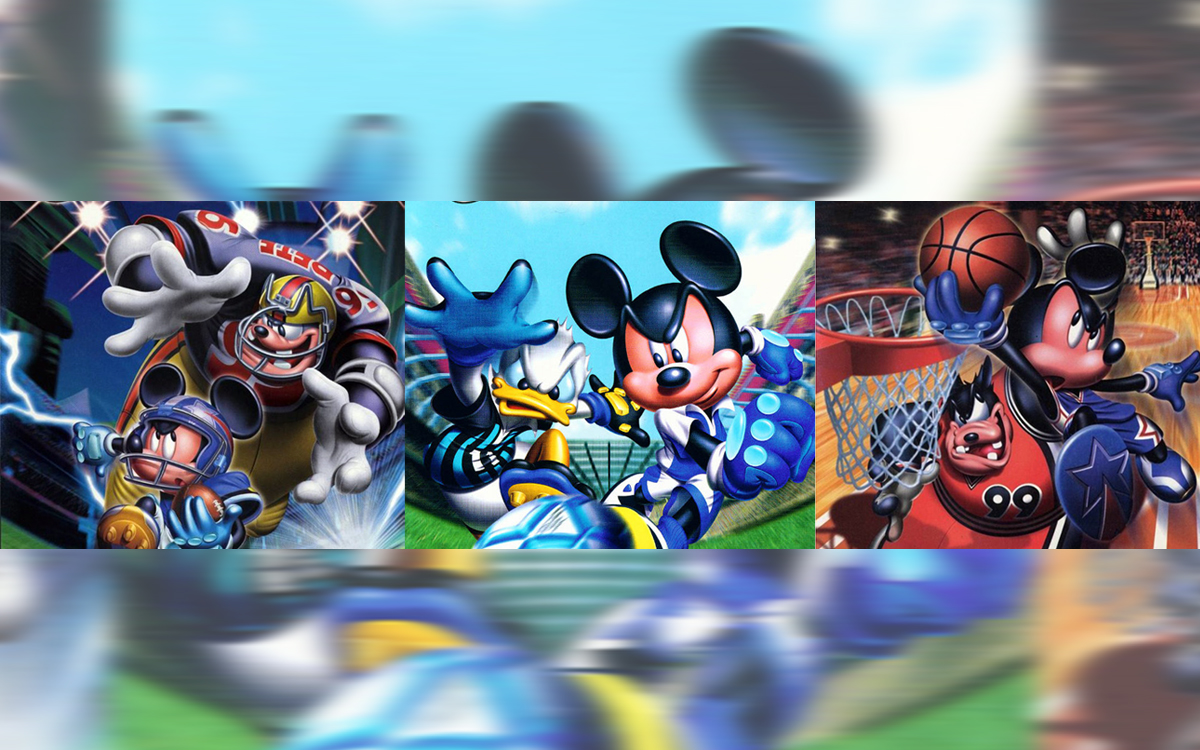
Here’s another look at what Noe Knows about classic video games – Disney ones. But before that, I (Fab) want to let you know about an exciting, fun Disney fan event happening October 13 – and this one just can’t be missed . . .
It’s called Broadway to the Rescue, and it’s being put together by some great folks, my favorite one being our beloved leader and world-renowned cabaret chanteuse Dusty Sage! Broadway to the Rescue is a group of LA-Based Broadway professionals, started three years ago by Michael-Leon Wooley, who support Hope of the Valley Homeless Mission, which provides an array of vital services to the ever-growing homeless population in Los Angeles.

The roster of performers includes an impressive resume of nearly 100 renowned Broadway shows. To name a few: Hamilton, The Book of Mormon, Wicked, Hairspray, Les Miserables, Little Shop Of Horrors, The 25th Annual Putnam County Spelling Bee, Gypsy, Five Guys Named Moe, The Music Man, Dreamgirls, Joseph And The Amazing Technicolor Dream Coat, Mary Poppins, Miss Saigon, Flower Drum Song, Wonderful Town, Sweet Charity, The Wedding Singer, Footloose, A Chorus Line, Priscilla Queen Of The Desert, A Funny Thing Happened On The Way To The Forum, Annie, The Color Purple and many, many more!
Deets: Saturday, October 13, 2018 at the Montalban Theatre in Hollywood.
This year’s show is all DISNEY! Not-to-be-missed!
Tickets and information HERE
To get your hands on these oh-so-desirable tickets (they sold out last year and this year’s show promises to be even more elaborate and fabulous) just click HERE. You even get to pick your seats, right from the webpage!
Disney Sports Titles . . . Do You Remember?
Sport games were big business. In the year 2000 they accounted for around $800 million, which was divided between a few companies. By 2016 sport games would turn Electronic Arts (EA) from mainstream game developer into a $4.4 billion juggernaut. To be fair EA had plenty of non-sporting games in their lineup. Battlefield, Mass Effect, Need for Speed, Star Wars and Titanfall were other high profile games they had released. Sport games however were a steady source of income. They tried to have a franchise title out each year in each of the major disciplines. You could expect to see the celebrity-endorsed Madden commercials every fall in the USA. EA found a way to keep getting paid after each release. After selling physical and downloadable copies of the game they continued to support it with paid downloadable content. EA offered this extra digital content for their professional soccer, football and hockey licenses to the tune of over $650 million a year. You can imagine that this money was not overlooked by Disney.
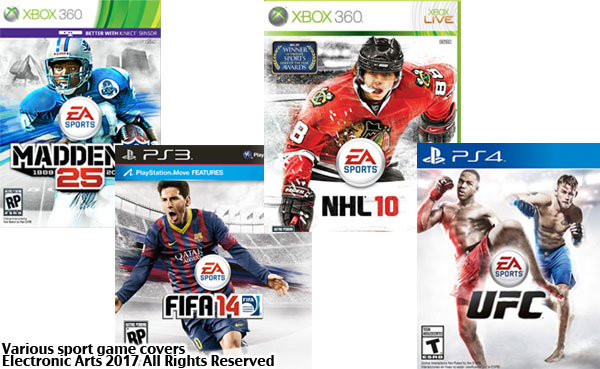
EA’s biggest moneymaker was not the Madden series, named after the legendary coach-turned-commentator John Madden. Football was an institution in the USA but it was far from being the biggest draw in global sports. The FIFA (pro soccer) series was more important. The franchise had sold over 100 million copies since it debuted in 1993. This was why Konami and Disney made sure that soccer would be the first game to launch the Disney Sports Network (DSN) series to the world. Konami did have a Disney American Football game in the works but it was scheduled for a much later date.

When it came to sports Konami had a patchy record. The studio was great at developing original titles and turning them into franchises. When character games featuring Sonic and Mario took off in the late ’80s / early ’90s they tried the same with their own IP, like Frogger. But that wasn’t the only series that became big. Look at Dance Dance Revolution, Castlevania and Metal Gear Solid for proof. Yet sport games were always a challenge. Those types of games had their own group of followers which didn’t necessarily buy into other genres. Sport games were confined by rules and regulations. They were not as open-ended as action titles or space shooters. Worse yet they required strict licensing agreements. In the early days of arcade and console development Konami created a couple of sport games with generic logos and fake marquee players.
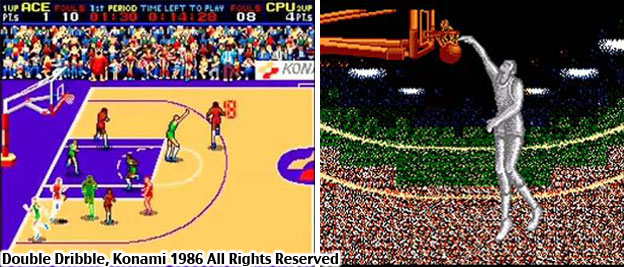
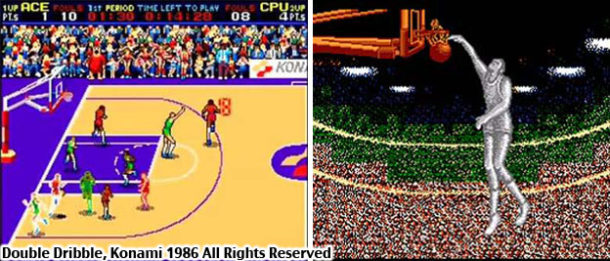
Konami’s first sporting hit was Double Dribble, a basketball game from 1986. It was a good basketball game for the time, which was made memorable by full-screen slam dunk shots. The grainy black-and-white pictures were revolutionary. They were like watching a highlight in the middle of the game. The following year they released Blades of Steel, a pro hockey game. Blades of Steel was a good hockey game made great by the addition of a fight mode where players dropped their gloves and traded punches. Both of these games were taken from the arcade and brought to the NES, making millions of sports fans happy. Aside from these two games Konami had limited experience working with the genre.

In the ’90s Konami saw the success that EA and other studios like SNK and SEGA were having with pro soccer. In the summer of 1995 Konami released International Superstar Soccer. It was one of the last sprite-based titles the company would develop. During the production of the game, they were working with the original Playstation development kits. At the end of the year they released a second soccer game that was even better received; Goal Storm – World Soccer: Winning Eleven. The name would be shortened to Winning Eleven in future releases. More important than the name was that this game was polygon-based. Konami finally had an answer to Sega’s Virtua Striker, the first arcade 3D soccer game from 1992. Konami was able to make their own 3D soccer game but this time for home consoles.

Winning Eleven was a revolutionary title that got some attention in the USA. Console fans had never seen a 3D game that operated as fluidly and looked so realistic. The characters ran and moved like real-world players. By comparison John Madden ’97 was also on the Playstation but it was still using flat, cartoonish, 2-dimensional sprites. The shift in technology forced EA to adapt or lose their fans. Konami would have different internal teams working on each revision of the series. Each group brought in their own unique take on the sport so that no sequel felt the same. In 2001 the series was relabeled Pro Evolution Soccer or P.E.S. for short. To this day there were fans arguing about which development team made the better product, those working on Winning Eleven or those working on P.E.S. Not that it mattered, Konami had a worldwide following, they were making money and they had the framework on which to build Disney Sports Soccer from.

In the USA, Disney Interactive had a lot to say about the proposed franchise. It wasn’t every day that they were partners on console-exclusive titles. The Japanese developers at Square and Konami needed help and insight from the US team. Concept artists and designers from the west advised on Kingdom Hearts and the Disney Sports Network at the same time. They aided with the early 3D models of the Disney mascots. For Konami specifically, they were helping with the direction of uniforms, colors, and stadiums. Disney Interactive highlighted the things that drew audiences to sporting events in the USA. They needed to get the Japanese developers to understand that the USA was obsessed with sports. We had multiple cable and satellite channels running 24-hours a day dedicated to sports, interviewing coaches and gossiping about athletes with the same intensity that the paparazzi saved for celebrities.
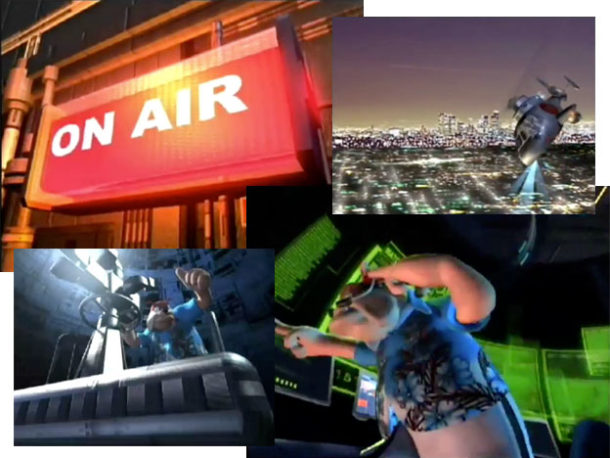
Disney Interactive wanted to make sure that this obsession was accurately reflected. Every game in the Disney Sports series actually began with a trailer. Audiences were shown an animated television studio with dozens of screens covering various sporting events. A bulldog producer called out orders to his cameramen and they changed the shots they were filming. We saw a helicopter flying above a city and even a shot of a mouse-eared satellite floating in space. The DSN logo appeared with all the fanfare of a real network.
In the USA athletes were treated like royalty. With that said no sports personality could be bigger than a Disney icon. This was why it was important to bring the characters to life. Imagine how wonderful it would be to hear your favorite mascot talk about the upcoming game. Each personality would get a chance to shine and no two interviews would be remotely alike. Konami worked with Disney Character Voices a few months before the GameCube game was released. They recorded at Skylark Sound in North Hollywood.

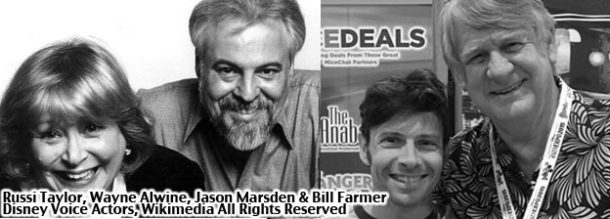
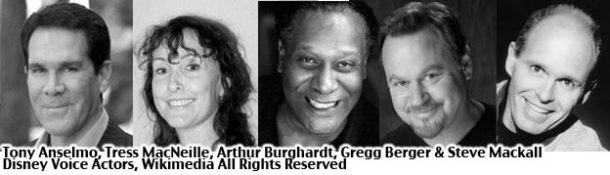
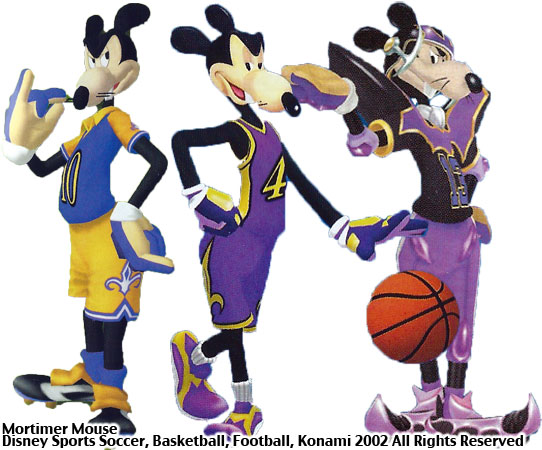
As with Kingdom Hearts it was pretty much a who’s who of classic voices. Russi Taylor as Minnie Mouse, Huey, Dewey and Louie. Wayne Alwine as Mickey Mouse. Tony Anselmo as Donald Duck. Tress MacNeille as Daisy Duck. Bill Farmer as Goofy. Jason Marsden as Max Goof. Arthur Burghardt as Pete. Jim Meskimen as Mortimer Mouse. I cannot recall if Gregg Berger or Steve Mackall did the voice of the Big Bad Wolf but the character was in the series and both of the actors did additional voice work in the game. The actors recorded individually. The studio made sure to include dozens of responses for random questions as well as general sound bites that could be put in different titles.
Think what you will about Mortimer but hands down he had the best quotes in the game. When asked about his victory he would sometimes say “My dear man, you really should watch me play more.” and “I’m always at my best when the ladies are around.” Right on the 15th anniversary of the series I managed to get an interview with Jim Meskimen about his role.

Noe: Mortimer has a very distinct voice, created by Pinto Colvig, how did you find your take on it and how is it similar or different to Pinto’s?
Jim: I tried to match him as much as possible, given my vocal qualities. I think I came pretty close. It was my first assignment for Disney Character Voices, and with working with director Ben Hoppe, who is now one of my very best friends. So it was a nice time. We often joke about it. Pinto had, at least in that character, a rather “old fashioned” American dialect, which is hard to pinpoint, but I worked to bring that forward so that it still had that flavor.
Noe: What sort of direction were you given while recording the games, were you allowed to ad-lib?
Jim: No adlibbing that I recall. The game had very specific things it was trying to communicate to the player, and my job was to simply communicate those concepts while sounding as much like the model Mortimer as possible.
Noe: Did you get a chance to record any dialogue with the other actors, if so how was it working with them?
Jim: No, I was alone.
Noe: There are many lines and phrases that each character speaks in the Disney Sports series. How many hours / days did you spend recording the character?
Jim: It’s quite a few years ago, but I think we did it all in a couple hours. The lines were pretty short!
Noe: Any favorite memories or funny stories from those recording sessions?
Jim: Just that Ben Hoppe the director and I have carried the phrase “Do you want this button?” forward from that session as a touchstone.

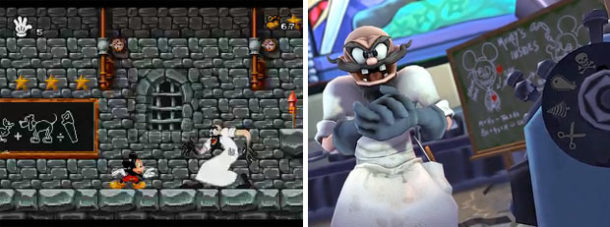
Noe: You more recently did the voice of the Mad Professor in Epic Mickey 2: The Power of Two (Junction Point Studios, 2012). How did you research for that character?
Jim: I looked at the small clip of the Mad Doctor character and got an idea of what was the quality of his voice… he wasn’t really in much, and when he was, he was mainly laughing maniacally. It was a pretty fast process.
Noe: The Mad Doctor did most of the singing in the game, did you ever expect to be the lead singer in a Disney musical?
Jim: I certainly did NOT. And it stands as one of the most challenging assignments I’ve ever had. I assumed there were many actors singing on that game, but the Mad Doctor had the bulk of the musical to do… there were a lot of numbers! I don’t read music, so it was especially challenging, given the level of complexity of the compositions and melody. But Ben Hoppe once again saved me by allowing me to sing the numbers a few bars at a time–I wouldn’t be able to perform any of them in concert! When I heard the final tracks, fully orchestrated and mixed, with my Mad Doctor voice singing (much more than the original Mad Doctor ever did) I was amazed. But it was also strange to know that nobody would ever really hear this huge musical production in its entirety, just as moments in a game… it was really kind of weird, like “what was this Broadway musical I was in?”
Noe: If you could voice a Disney character in a new game, it doesn’t have to be Mortimer or the Mad Doctor, who would you choose and why?
Jim: I enjoy doing the Robin Williams Blue Genie for Disney, and I’d be happy to do that forever.
Noe: You are well known as an impressionist, a “Jimpressionist”, have you ever pulled a prank pretending to be someone else?
Jim: Many times, too many to count! I try to not be mean about it, but just do fun stuff. My co-stars on the TV series IMPRESS ME, Ross Marquand and Piotr Michael and I did prank calls to people for a video for SoulPancake a few years back as Deniro, Pacino and Christopher Walken. I think we fooled a lot of people, and made their day.
Noe: Has a celebrity ever asked to see your impression of them?
Jim: Not yet.

Noe: How did you get involved in the Pop TV show Impress Me?
Jim: I worked on writer/director Ben Shelton’s webseries The Flip Side, and noticed that he knew my friend Ross Marquand, who in those gentle, pre-Walking Dead days was a struggling actor/impressionist like me. We all met and discussed the life of actors who do voice matching, and Ben created the pilot for a web series that eventually became the TV series IMPRESS ME.
Noe: What advice could you give people that want to be voice actors?
Jim: Record yourself a lot and force yourself to listen to it over and over again until you are very comfortable and familiar with how you sound naturally… then work on changing your voice to create character, emotions, story-telling, or celebrity voices, in whatever area you are interested in most. But first, and an often omitted factor, is this idea of becoming incredibly familiar with your own voice. Many people are not at all comfortable with their voices, and that will make it hard for you to progress and become a pro.
Audio played a very important role in the Disney Sports series. Sport games never really had player interviews to spruce things up. Sure today there were entire “career modes” featuring animations of actual players and coaches but when sport games originally went into 3D this was unheard of. There had been sports commentary during the sprite-based era with people like John Madden making observations and even offering advice in game. Prior to Konami no studio had ever gone to the trouble of creating random interviews before or after each game.
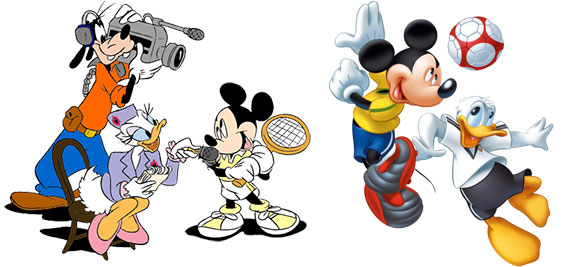
The original concept from Disney Interactive called for cartoon sports commentators in the DSN studio booth talking up each player and team before the game. After the match they would then conduct interviews on the field or in the locker room. Konami and Disney Interactive didn’t have time to create a DSN set or animate fictional hosts, they did however have an announcer whose voice appeared in every game. Bob Bergen (then then the Legends of the Hidden Temple host) flew solo in this regard. He captured the enthusiasm of a veteran host and the quick one-liners of color commentary. My family loves the line “winner, winner, chicken dinner” which comes up too rarely after some matches. Although he did not do any sort of pregame interviews he did break down the team players at the start of each match and interviewed the team captain after each match.
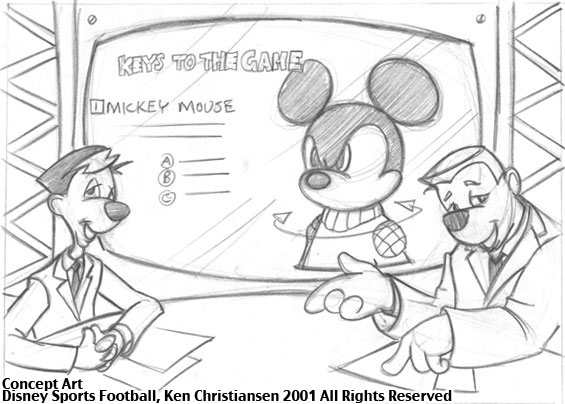
During the casting stages Konami realized there was no way they could have a game ready to go with the launch of the GameCube. They needed it available for preview at gaming events, such as E3 in Los Angeles and the Tokyo Game Show. Vendors needed to see the title and gauge the audience reaction before they ordered it at least a year in advance. The press and public were also eager to see what the studio was working on and whether or not it would be a hit. This would be a make or break series for the company. There were tremendous changes between what was shown in the earliest builds and what was released.

This was nothing new for the industry. Many games changed during development and the final product often had a lot more polish on it. It made sense that Konami went with the soccer game first. It controlled the best, looked amazing and felt closest to a finished product. It was the one that truly captured the spirit of the DSN series. Konami’s Winning Eleven / P.E.S. team had done a fantastic job adapting the engine for the cartoon characters. Disney Interactive had created some brilliant character models. The mascots didn’t move like people but instead like cartoon characters. When they ran they leaned full forward, when they tripped they flailed their arms, when they collided they crashed and fell. Little stars would appear over their heads. The quality of these characters and their animations actually improved in every game the studio published.
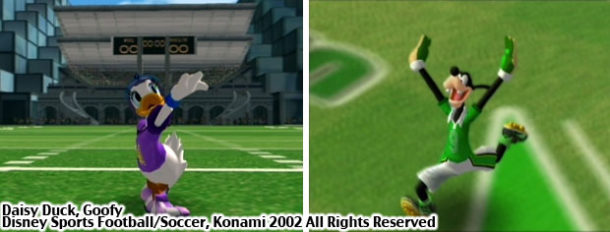
Animations were not the same across the board. The gait of a character like Goofy was lanky and loose while someone like Donald Duck was tighter and more controlled. Imagine the challenge that the animators had. How would you animate a character going from position to position when they had short stubby legs and a wide stance? How could someone like Mickey be able to realistically keep up with a much taller Mortimer? The team at Disney Interactive figured out the physiology and made it consistent with the cartoon cycles. Facial expressions and animations were then added to all the characters including the teammates. These were things you couldn’t make out in the middle of the game but if you paused the action and zoomed in with the camera you could see that the characters actually turned their heads and followed the ball with their eyes. There were random victory animations after each goal which were different for each character. The teams celebrated together, and cried in defeat. Konami showed the world that the Disney icons were made for gaming. These and many more details led to the game being reviewed as one of the best sports titles ever published. We will dig into the Disney Sports Soccer a little bit more on the next blog. Until then please leave a question or comment and I’ll try to get back to you.
Please help support MiceChat by clicking here! we’re on Patreon, and support AITAF and Ryman Arts.