



“I was taking the pirates that were real from history, like Morgan, Captain Kidd, and Blackbeard. These guys would shanghai somebody and force them to become a member of the crew. They would have to sign the articles with their own blood. […] Most pirates died of venereal disease that they got in bawdy houses in various coastal towns. I was sorry to read that because it took a lot of the glamor out of these characters. So at first I wanted to explore the possibility of using real pirates in the show, but later I decided that that wasn’t the way to go.”
If you know Pirates of the Caribbean very well, you’ve probably read that quote from Marc Davis multiple times in your life. It comes from the Fall 1999 edition of The E-Ticket, a magazine that did much to cement certain ideas about this attraction in the consciousness of the public. Marc’s words are easy to believe, but also only sort of true.
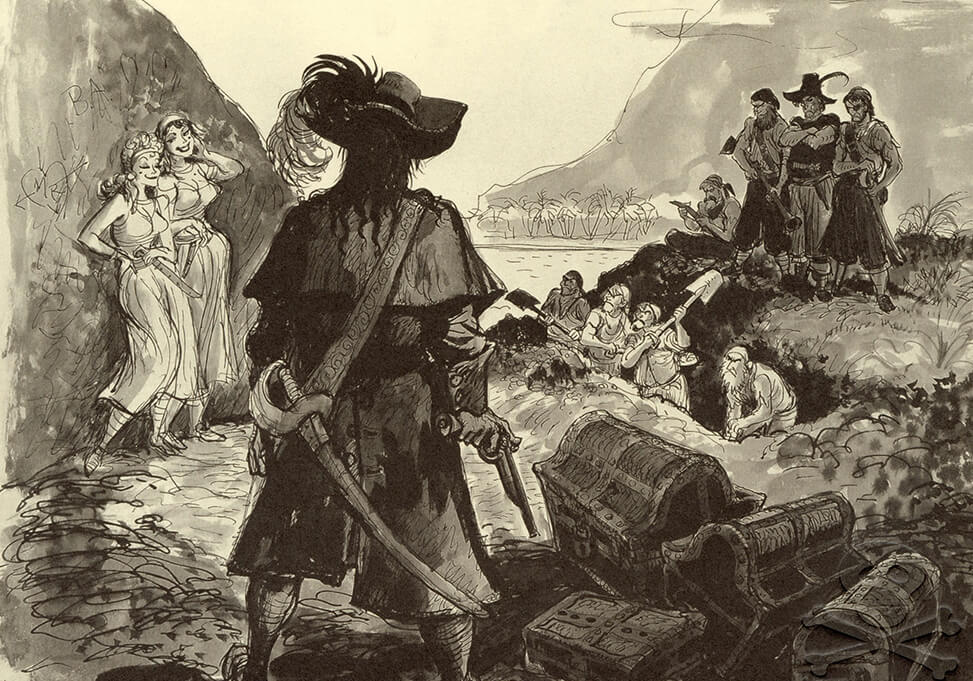
Disneyland had had some sort of Pirates attraction in development since shortly after the park’s opening — a fact made clear by the strategic placement of “Laffitte’s Anchor” in Frontierland in 1955. Early development on the attraction was begun by Bruce Bushman and Sam McKim, early development which fixed ideas such as a port setting and a fire finale in place. But Bushman left Disney in 1958, and Marc Davis inherited the project in 1961. Upon delving into the research material, Marc initially did sketch historical pirates and situations, appropriate given that the brief for the “Rouge’s Gallery” was for something like a wax museum.
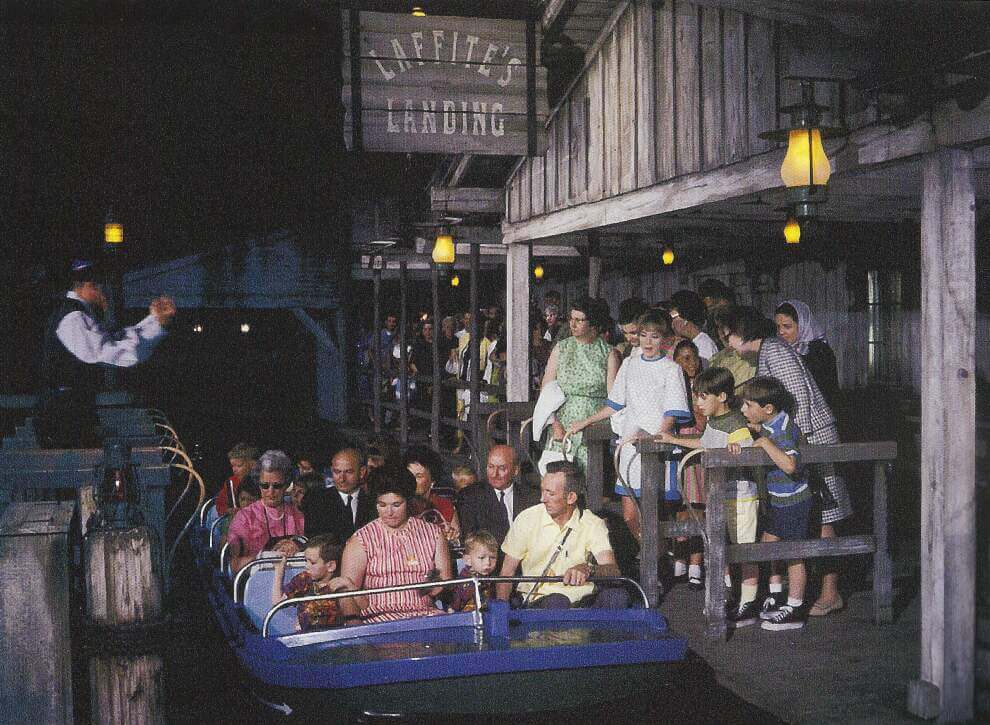
 But it’s not like this historical approach just vanished; in fact there were three prominent, historical pirates featured onride in 1967. The attraction’s boarding area highlighted our first historic figure: Jean Laffitte.
Laffitte was not technically a pirate; he operated out of the swamps south of New Orleans over one hundred years after the end of high sea’s piracy’s “Golden Age”. It’s kind of like calling John Wayne a cowboy; he wasn’t really but the hat did fit. Laffiite was best described as a smuggler. The Napoloenic Wars in Europe had constrained the supply of luxury goods in the United States, a situation Laffitte exploited by smuggling items into New Orleans by way of flat-bottomed boats. Famous for his role in the Battle of New Orleans, Jean Laffitte may be the first person in history to be called a pirate in a complimentary way.
Laffitte’s Landing, the attraction’s boarding area, is surrounded by tiny skiffs with lanterns resting inside them. This is absolutely meant to depict smuggling activity. Also, since we board our own boats at Laffitte’s Landing, does this make us pirates too? Food for thought.
Further along in the atrraction was the most recognizable historical pirate. Blackbeard, real name Edward Teach, operated along the southern coast of the American Colonies in 1717. Teach is one of those colorful historical characters where it’s hard to believe he was actually real.
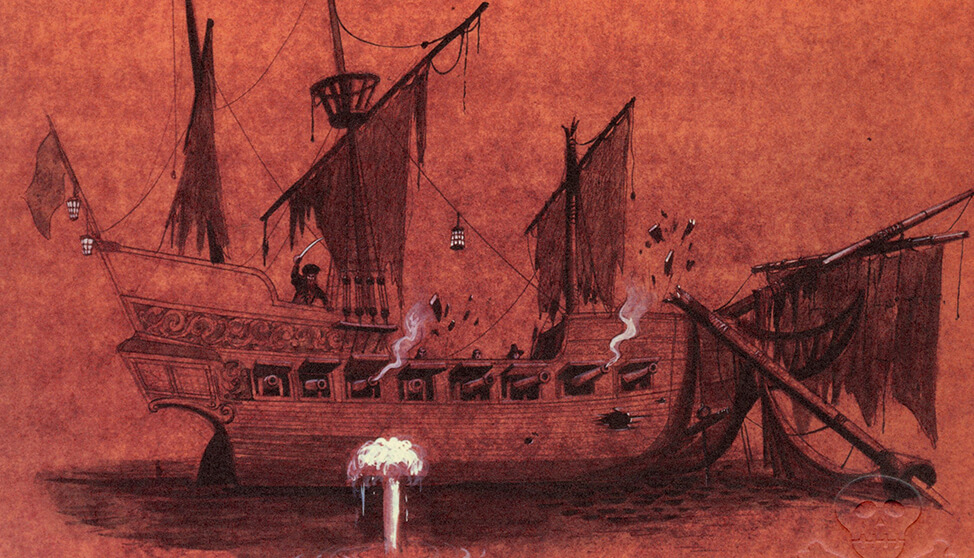
Genuine pirate behavior during the “Golden Age” of piracy had as much to do with theft by intimidation than anything. Thats the entire point of running up black flags with skulls on them; victims of piracy would almost always capitulate immediately. Blackbeard made this whole ethos into an art. His ship, the Queen Anne’s Revenge, was fitted with 40 war cannons and was the lead vessel in a pirate flotilla of 300 men. During the persuit of a vessel, Teach would appear screaming bloody murder on the decks on his ship, fuses burning below his hat, making his red face and huge beard appear to be engulfed in flame and brimstone. Despite operating for a mere two years until his defeat in 1718, Blackbeard became an iconic villain, the pirate to beat all pirates.

An early version of the attraction’s “Bombardment Bay” scene, featured in the Imagineering model seen in the “Disneyland 10th Anniversary” television special, was much more elaborate and featured a walking the plank scene. When the attraction’s endlessly rising development costs necessitated some scaling back of ambition, the scene became a battle between the pirate ship and the island’s fortress.
Holding the whole scene together was the ship’s captain, Blackbeard, standing on the deck of his pirate sloop and screaming bloody murder at his opponents. Blackbeard was used here as a shorthand to explain the action; history’s most famous pirate doing what made him famous. The switch to Barbossa in 2007 simply can’t help but be a downgrade.
Our third historical pirate is a bit tougher to spot, but he’s still there. One reason development on Pirates of the Caribbean stretched on for a decade was because Disney was incapable of creating animated dimensional human figures to the level of technical  sophistication they desired. In the end the development of Audio-Animatronics would be more or less subsidized by General Electric, the Google of their day, for the 1964 New York World’s Fair. In the meantime, Marc did what he could and created a number of concepts for the early 60s walk-through museum where a scene would be narrated by a minimally-animated figure off to the side of the main action. He drew two concepts for these narrators: Blackbeard (dead drunk; a parrot voiced his scene instead!), and Henry Every.
So who is Henry Every? Sometimes called John Avery, Every was the most famous and influential pirate of his day. His deeds filled the imaginations – and ambitions – of a million morally questionable sea-dogs, because he oversaw the most successful pirate raid in history.
After mutinying and disposing of his ship’s captain, Every’s ship the Fancy went a-pirating along the coast of Africa, eventually crossing to Madagascar and waiting at the mouth of the Red Sea for the “Treasure Fleet”. This yearly pilgrimage was undertaken by the Grand Mughal of India and his family, and the Fleet was famous for its abundance of wealth. This caravan of vessels consisted of a gigantic treasure-laden warship and a smaller consort ship owned by a wealthy merchant. The pirates gave chase, picked off the consort ship, and after a week successfully overtook the treasure ship.
The plunder from this ship is literally incalculable, and while subsequent events may have caused the actual value to be overstated, a conservative estimate puts its value at a modern equivalent of $200 million. This single raid was one of the two or three most profitable thefts in history, the theft that inspired every other pirate crew for the next generation.
 But what Every was also most famous for was his actions during this raid. You see, there may or may not have been a Mughal Princess aboard the ship, and Every may or may not have forced his attentions upon her. Following this raid, Every disbanded his crew and vanished. He was never located and the East India Trading Company repaid the Mughal King for his losses. Perhaps the most successful pirate of all time got away scot-free. This story made him a hero in London; Every had struck at an enemy of England in a place outside the law, like the Lone Ranger, and was said to be fabulously wealthy. Broadsides and ballads were printed, stories were told, and the legend became the basis for a 1712 play called The Successful Pirate.
So where is Every on the ride?
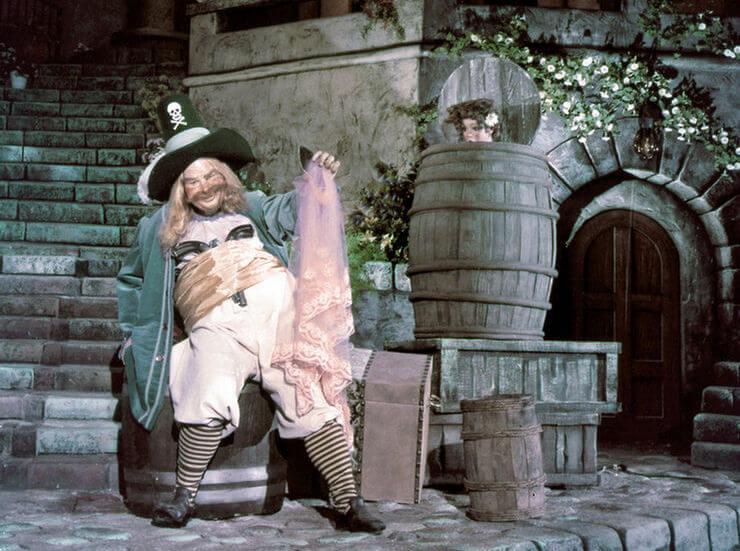
As development on the attraction continued, the “Chase Scene” presented some issues for designers and the decision was made to insert a voiced pirate character to give the scene a little life. Marc went back to his drawing board and, knowing that this character would be appearing inside a scene with pirates persuing wenches on foot, decided to cast the role with Captain Every from his 1961 development drawings. Every became the “Pooped Pirate”, who rested on a barrel with ladies slip and high-heel shoe in hand and wondered where the “fascinating little old treasure” he had been persuing had escaped to. Telling casting.
And oh yes, there is a final Pirates of the Caribbean historical easter egg for those with a sharp eye. If you take a close look at the Disneyland attraction poster, the side of the “treasure chest” has an inscription copied directly from this illustration by Howard Pyle, the American illustrator who did much to fix the image of piracy in the popular imagination.
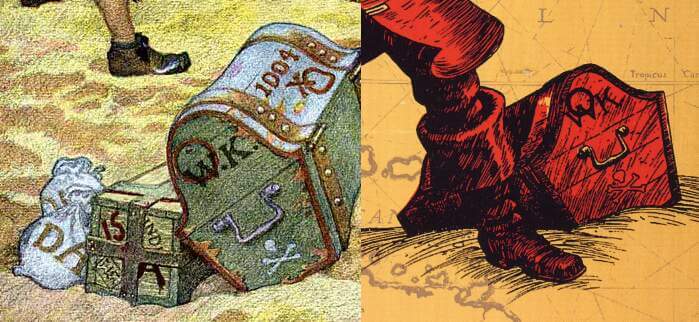
The detail is lifted from Pyle’s illustration of Captain Kidd, who was actually hired to stop, not cause piracy… but history had other ideas. But that’s a story for another time.
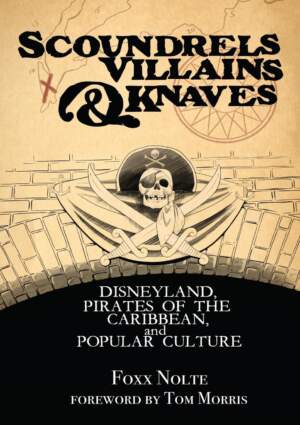
If you’d like to learn about more historical pirates and piracy and how all of these relate to the Disneyland atrraction, then my new book Scoundrels, Villains & Knaves: Disneyland, Pirates of the Caribbean, and Popular Culture is the deepest deep dive ever assembled. Just some of the highlights include:
– coverage of every version of the attraction
– the most complete history of the development of the shows for California and Florida ever assembled
– the story of the rise and fall of Captain Jack Sparrow
It releases on August 15 from Inklingwood Press, and can be pre-ordered at the link above. I will also be at the MiceChat booth (#219 in the D23 Emporium) at the D23 Expo on August 10, 2024. You can take a look at all of my books and chat with me, so stop by and say hi!