



This blog series has given examples of how Marvel has brought in traditional comic book storytelling and character development to television. If you are joning us in the middle, please take a moment to review parts One, Two, and Three first.
Agents of S.H.I.E.L.D. demonstrates that heroes come from many different backgrounds. There are spies, computer hackers, biologists, engineers and soldiers but none of them had super powers. They are all willing to lay their lives on the line in order to protect the public. The willingness to sacrifice themselves for the greater good was a defining characteristic for a hero.
Yet there were villains that were also willing to die for their cause. Comic books had always relied on extreme cases of good versus evil in order to tell a story. The biggest tragedies were sometimes the result of a misguided villain. In their mind they were doing the right thing. Perhaps it was to save humanity or even stop a war. They were convinced that they were doing the right thing despite the objections of allies and even family members.
The first season of the Agents of S.H.I.E.L.D. introduced Deathlok but also a second character from Marvel canon. Dr. Franklin Hall, as played by Ian Hart, was a physicist working on a major scientific breakthrough. He discovered a fictional element called “gravitonium” and was attempting to understand the bonds that held the universe together. He was kidnapped by a billionaire tycoon looking to turn gravitonium into a new source of power as well as a dangerous weapon for HYDRA. Hall played along with his captors and continued working on his project on a remote island near the coast of Malta. What he planned on doing was activating a device and using the gravitonium to collapse the building and kill himself and his captors in the process. He wanted the discovery to be lost for all time so that neither HYDRA would ever be able to use it. Agent Coulson tried to rescue Dr. Hall, he wanted to convince him that his discovery could revolutionize the world. Dr. Hall wanted nothing to do with Coulson or S.H.I.E.L.D., he knew that if either side had access to his technology that they would eventually turn it into a weapon. He turned on his device and began destroying the enemy base. Dr. Hall was pulled into the core of the gravitonium and was seemingly killed in the process. What happened instead, for those that were familiar with the comic book and cartoons, was that Dr. Hall would become transformed into a super-villain.
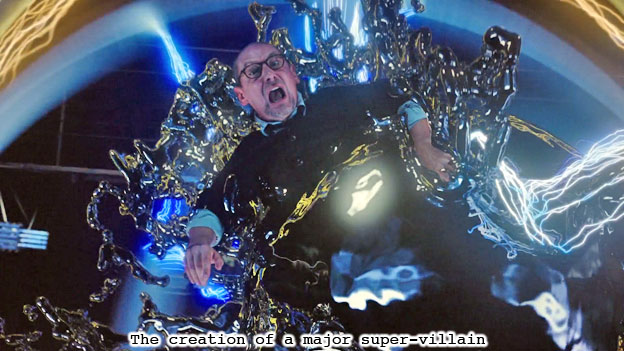
This was an important moment in the history of comic book television shows. Previous shows revolved around an origin story for the main character and on occasion for a villain. Rarely however did the show capture the intensity and psychology that made the greatest villains. Imagine how much of an impact it would have on audiences to see how other villains came into being over the course of a series.
What about the great Spider-Man or Fantastic Four villains? They did not simply put on a costume and decide to rob a bank. Many had experiences that were so traumatic that they were almost forced into a life of crime. The characters that were created by a tragic fate rather than because they were evil were the most sympathetic. Dr. Hall could not be considered a major villain to most comic fans, possibly because he did not really have a long-standing rivalry with a particular hero. His alter ego, Graviton, was rarely seen but was nonetheless one of the most powerful villains ever created. You may not be familiar with how powerful Dr. Hall was in the comics but rest assured that he could be considered a top-level player.
A good comparison for Graviton would be Magneto, the X-Men villain. Max Eisenhardt aka Erik Lehnsherr was a young man when the Nazis put him and his family in a concentration camp. Max was a mutant but kept his powers hidden from the world. After the war, Max was the last one left; the horrors that he witnessed first hand left him with a tremendous hatred for humanity. He was determined that he would eradicate humans from the world and rebuild it with an army of mutants. He had good intentions in his mind but of course was willing to commit the same crimes that the Nazis did in pursuit of his goal, making him one of the most tragic villains in comic history.
The persecution that the Jews and other minority groups felt was the basis for the mutant characters in the Marvel Universe. Max went by his new name Magneto and struck fear wherever he went. He could control metal, in particular anything that could be magnetized. In the comic books he could reduce skyscrapers to rubble, send oil tankers through the air and knock fighter jets out of the sky. He was so powerful that it often took the combined forces of the X-Men to stop him. Magneto had a reputation among comic book fans as one of the most powerful mutants ever to walk the Earth. His live-action appearance in the X-Men films did not disappoint.
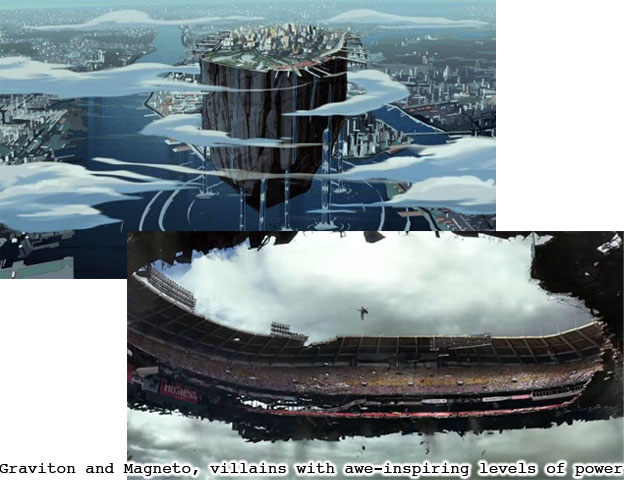
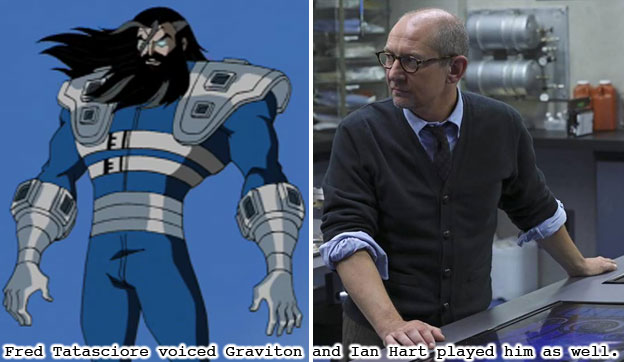
Whether he was pulling the Golden Gate Bridge apart to carry his mutant followers to Alcatraz or lifting the Washington Senators baseball park and dropping it over the White House there was no spectacle that could rival Magneto in film. That was of course unless he was compared to someone like Graviton. Dr. Hall had control over gravity. He could make any object completely weightless or increase its density. In Avengers: Earth’s Mightiest Heroes the character decided to humble the city that imprisoned him. Graviton pulled the island of Manhattan out of the ground and dropped it on Thor. Talk about making a statement! Hulk voice actor Fred Tatasciore voiced Graviton in the cartoon. In the cartoon Graviton had a slightly different origin than the comics and AoS. He still made a lasting impression on audiences. Graviton was the first major villain that took all of the Avengers in order to be stopped. He was essentially the reason for creating the team.
Marvel wouldn’t have to worry about getting the rights back for the X-Men if they were willing to use Graviton in a live action feature. Imagine the type of special effects budget that it would take to pull off a shot of Graviton using his powers against the Avengers. Only Disney could afford to flip the bill on something like that. Of course the question was whether or not Marvel would bring the character back in the Agents of S.H.I.E.L.D.
The show had teased that Dr. Hall was still alive, trapped inside of a well of suspended liquid gravitonium. S.H.I.E.L.D. had put it away in a secret location, but HYDRA eventually stole the case and returned it to Hall’s kidnapper, the tycoon Ian Quinn. It was not known if Graviton would ever appear in the series but the producers did not introduce new characters if they did not also have plans for them. It would make sense if Hall returned much later. The time trapped inside the gravitonium would have warped the mind of Hall and turned him against S.H.I.E.L.D. Of course, if Graviton did return in a future season, then it would take the Avengers to bring him down. Talk about teasing a television rating’s topper!
The second season of Agents of S.H.I.E.L.D. was off to a tremendous start. The writing was sharp and leagues ahead of the other comic book shows. The heroes and villains were shaping up and there were many more adventures to look forward to. If there is one secret weapon that Marvel has that DC seemes to miss time and time again it is with the cast. The next installment will look at the characters that make this series unique.