



If you’ve ever driven along A1A between Daytona Beach and St. Augustine, you’ve probably gone through the small town of Marineland. It is in this sleepy Florida town where the world of modern aquariums, dolphin research, and indeed the entire field of oceanography began.
The park opened to the public as Marine Studios on June 23, 1938 as the world’s largest aquarium to a crowd of more than 30,000. Compare that to 1971 when Walt Disney World opened, when the Magic Kingdom had only 10,000 tickets sold for the day!

Inquisitive visitors were invited to peer through more than 200 portholes surrounding the exhibits to view aquatic life within the lagoons. The facility featured the first oceanarium which housed multiple species of animals, as well as the first group of dolphins ever raised in captivity.
Arthur McBride, Marineland’s original curator, utilized this unique opportunity to study dolphins. McBride eventually discovered how dolphins breathe, mate and how important hearing was to their complex social behaviors. Early scientists also discovered such well-known and documented phenomena as dolphin echolocation and communication at Marine Studios, which brought the understanding and training methods of aquatic mammals to new levels. Through this research, Marine Studios would become the first aquarium to successfully breed bottlenose dolphins and capture these moments on film, marking the first successful dolphin birth in human care in 1947.
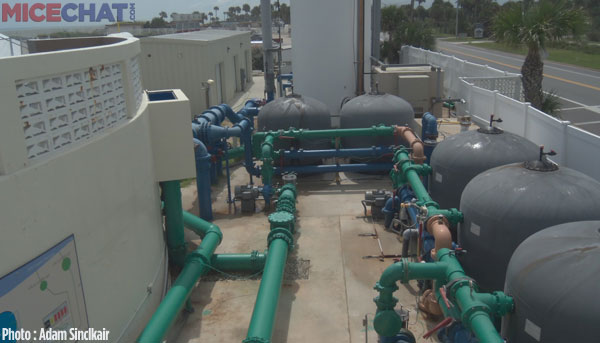
In order to house numerous aquatic species in one exhibit, an interesting challenge faced the men whose vision and design was a first-of-its-kind. The lead architect, Fred Hendrich, alongside lead engineer M.F Hasbrouk, worked diligently to build large exhibits combined with a pump system—a first for the aquarium industry. Engineers created a water system using electric pumps to pull water from pipes that ran under the beach. Marineland became the first aquarium to pull a continuous exchange of water from the ocean. Electric pumps powered the system, but a gas-powered pump also existed on standby in case of a power outage. This pump was able to pull five million gallons of fresh ocean water every day, maintaining healthy water quality for the exhibits.
Overall, the exhibits collectively held 84,000 gallons of water that would be refreshed six times per day. The founders put a great deal of emphasis into creating the perfect habitats, ones which would be functionally sound for research and for engaging guests. One of the founders, Douglas Burden, described the facility as “scientific education entertainment” of which the main priority was acquiring and conserving distinct aquatic species.
Marine Studios was an underwater filming studio designed to provide its guests with a window to the ocean by creating a moving experience that showcased marine animals in a naturalistic habitat, in which filmmakers could pioneer a new way of filming. Over the years, Marine Studios served as the set to numerous films such as Revenge of the Creature (1955) and Zaat (1971). Marine Studios also served as the set for an episode of ABC’s Benji Takes a Dive (1981), which memorably featured the first SCUBA diving dog.
The visionaries who worked together to create Marine Studios were some of the most successful well connected men of their time. One of the original founders was Cornelius Vanderbilt Whitney, grandson of Commodore Cornelius Vanderbilt. Whitney used his family legacy to create business ties, which helped him establish Pan American Airways and go on to finance Gone with the Wind. Douglas Burden, trustee of the American Museum of Natural History and cousin to Whitney, served as the first president of Marine Studios. Grandson of the legendary Russian novelist, Count Ilia Tolstoy, acted as the studios first vice president and general manager. The founders’ collective fame and Marine Studios’ additional attractions helped transform the park into the first multi-million-dollar, man-made attraction in the U.S.
Marine Studios evolved becoming home to aquatic animals, animal trainers, scientists and researchers. As Marine Studios began to acquire more species of marine life and focus more on the guest experience versus filming, the founders re-wrote their mission to include an emphasis on educating the public.
Marineland Florida was home to the world’s first trained dolphin, Flippy, who contributed to the park’s rise in popularity. Soon guests packed the stands to watch multiple dolphins perform in Marineland stadium. Marineland became internationally known for having the first-ever dolphin shows and exhibits showcasing various forms of marine life. By the mid-1970s, Marineland was welcoming more than 300,000 guests each year and continued to add new attractions including a 3D theater, penguin bar, gift shop, fudge factory and the famous Moby Dick lounge, a local water hole frequented by Ernest Hemingway.
Researchers from around the world were especially interested in studying marine life at such a close and accessible proximity. As a result, studies in marine science, animal training and water chemistry were pioneered at the facility. Being the first of its kind, Marineland served as the model on which many other aquariums, oceanariums and marine parks based their own development and design.
In addition to the groundbreaking work Marineland pioneered with bottlenose dolphins, researchers at Marine Studios made progress with many other species. In partnership with the American Museum of Natural History, scientists at Marineland created a method for administering anesthesia to sharks. Scientists at Marine Studios acquired a manta ray and were able to observe sleeping and eating patterns. This allowed the early scientists to collect data that is vital to our understanding of manta rays today. Today, manta ray research is conducted off the coast of Marineland twice a year to gain a better understanding of these unique animals.
While researchers at Marine Studios were able to study animals up close in their care, they began applying knowledge gained to animals in their natural habitats by responding to animal stranding’s and conducting surveys of ocean habitats. In 1954, a group of Marine Studios scientists became the first to see a pygmy sperm whale in the ocean while they were responding to a stranded animal. These discoveries later led to them acquire a pygmy sperm whale, becoming the first facility to have one in their care in 1964.
As the decades passed, time and the elements took their toll on the original structures, and newer, larger attractions began to erode guest counts, and the facility that had been the “9th wonder of the world” by the Florida Times Union was facing bankruptcy.
In 2001, a plan was created to transform the aging, outdated Marineland into a modern facility focused on creating important and memorable connections between humans and marine mammals. A destination where animals could be more easily observed by visitors and researchers, and guests could be inspired by a whole new level of connectivity with these dynamic creatures. In 2006, the older and outdated habitats were retired and Marineland’s dolphins were relocated next door to a brand-new facility.
On January 1, 2011, Georgia Aquarium purchased the park and renamed it Marineland Dolphin Adventure. Today, the modern 1.3 million-gallon facility is designed with the behavioral needs of the animal, the viewing capabilities of the guest and researcher, and the logistical needs of the trainer in mind.
Named on the National Register of Historic Places, Marineland Dolphin Adventure is specifically designed for interactive dolphin encounters and continues to offer a variety of interactive adventures, educating guests to gain a better understanding of marine mammals and inspiring conservation efforts on their behalf.
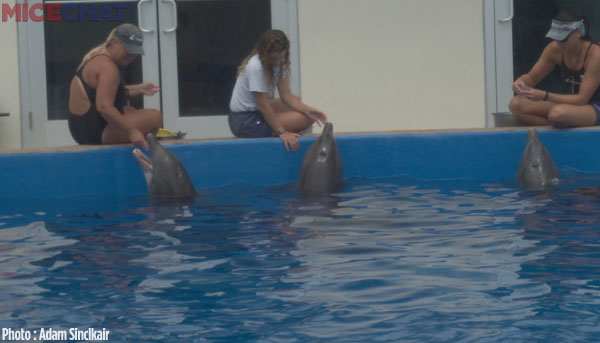
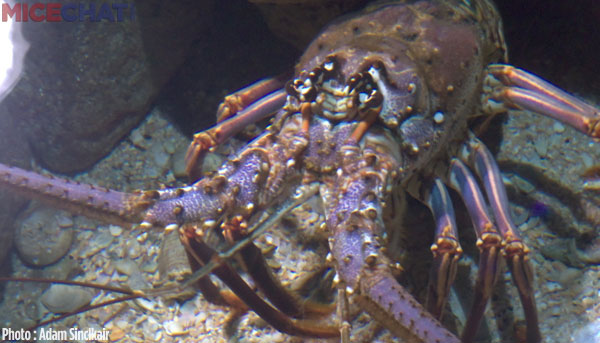
The park offers a wide variety of admission packages to fit virtually every budget. General admission, which allows visitors to tour the turtle exhibits, explore how the water filtration system works, and get a view of the 14 dolphins in the main tank, starts at $6.95 for children and $11.95 for adults. This entry level ticket gives you an idea of some of the work the park is doing to help further the cause of marine research, and provides you with a breathtaking view of th Atlantic Ocean.
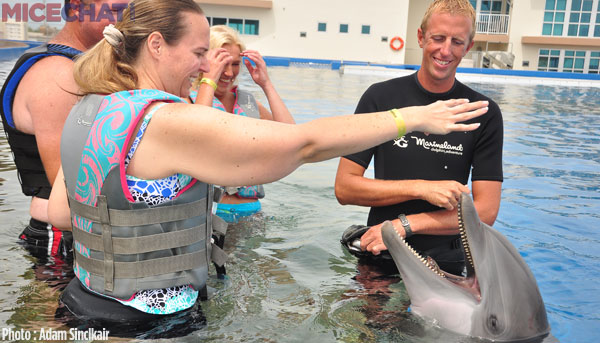
Of course, what is the point of visiting a dolphin encounter if you don’t truly get to interact with the dolphins? Starting at only $31.95, park guests are able to meet, greet, and feed one of the amazing bottlenose dolphins during a five minute long program. For $99, you can combine your passion for dolphins with your passion for art in the Dolphin Design experience, where you and your dolphin artist buddy create a one of a kind masterpiece!
The best part of Marineland Dolphin Adventure, of course, is the in water interaction you can share with the animals. For only $169 per person, you are able to become a small part of the dolphins’ watery world as you step into their habitat with a Marineland Dolphin trainer in the Discover Dolphins tour. There, you will be in the water for 20 minutes experiencing first hand what it’s like to be up close with these amazing animals.
If you really want to get wet, though, nothing beats the Immersion! For only $229, you not only have the opportunity to interact with the dolphins in shallow water, but are able to swim with them in the 40 foot deep water of the main pool. This experience provides you with a better idea of how dolphins truly are, and how much like us they can be. You are provided with a lifevest and mask so that even a novice swimmer will feel at ease. Photos of the encounter are available for purchase, and the training staff is more than willing to answer any and all questions you might have.

Marineland continues to work alongside its sister facilities, Georgia Aquarium in Atlanta and the Georgia Aquarium Conservation Field Station, located across from Marineland Florida, to conduct field surveys of local dolphins and respond to stranded or injured dolphins and small whales as part of the National Marine Fisheries Service’s Marine Mammal Stranding Network.
So, if you’re visiting Central Florida, and are willing to make a brief trip away from the themed attractions, plan a trip to the original marine park in Marineland, Florida. You’ll be glad you did!