


Tough times in the movie business, pressure to leverage AI, mergers and acquisitions reshaping the entertainment industry, and a need to consolidate power and make sure loyalists hold the top spots have led Josh D’Amaro to set aside his nice-guy image and sharpen the axe yet again.

Now it’s time to say goodbye to more of the company.
We’ve been reporting on the steady waves of layoffs at Disney over the last year, including the elimination of roughly 1,000 roles in April (Disney prefers the term “involuntary staff reductions”) and a second round of job cuts in July that significantly impacted Pixar, National Geographic, and ESPN. There were quieter trims before those, too: a marketing consolidation in January and about 100 salaried Disneyland Resort positions cut last October, neither of which came with an official headcount.
None of this is a surprise, and sadly, it’s far from over. In 2023, Disney announced a company-wide reorganization that would eliminate 7,000 jobs. But now, just five months into Josh D’Amaro’s tenure as CEO, Disney is setting its cost-cutting sights on the top of the food chain by offering eligible executives early retirement.
Voluntary Early Retirement Offer
The time-limited Voluntary Early Retirement Offer (VERO) is an “enhanced retirement package” available to U.S.-based executives at the Director through Executive Vice President level across the Disney Entertainment, ESPN, and corporate divisions (including those working on a temporary basis outside the U.S.). However, not everyone qualifies for VERO.
To take advantage of the offer, executives must have 65 points, a “score” that’s calculated by adding their age and the number of years they’ve worked for Disney, with a minimum age of 50 and at least 10 years at the company. It’s definitely important to note that the offer does not apply to contract employees, which includes most of the high-level Disney executives.

The offer comes with financial incentives as well as another perk reserved for Disney retirees: lifetime free entry to Disney theme parks on a Silver Pass (blackout dates apply). Executives who take the package also keep separation pay, continued vesting of existing equity awards, and healthcare at active employee rates. Notably, there’s no non-compete attached, so anyone who accepts is free to walk across the street and go to work for a competitor the next morning. That is not an accident; it’s an incentive!
Since voluntary retirements are almost always followed at Disney by mandatory layoffs, the other shoe will most definitely drop. Another thing worth noting is that voluntary buyouts also generally offer better terms than involuntary staff reductions, so we won’t be surprised if qualifying executives are motivated to retire early if they think their jobs are in danger.
Money Talks
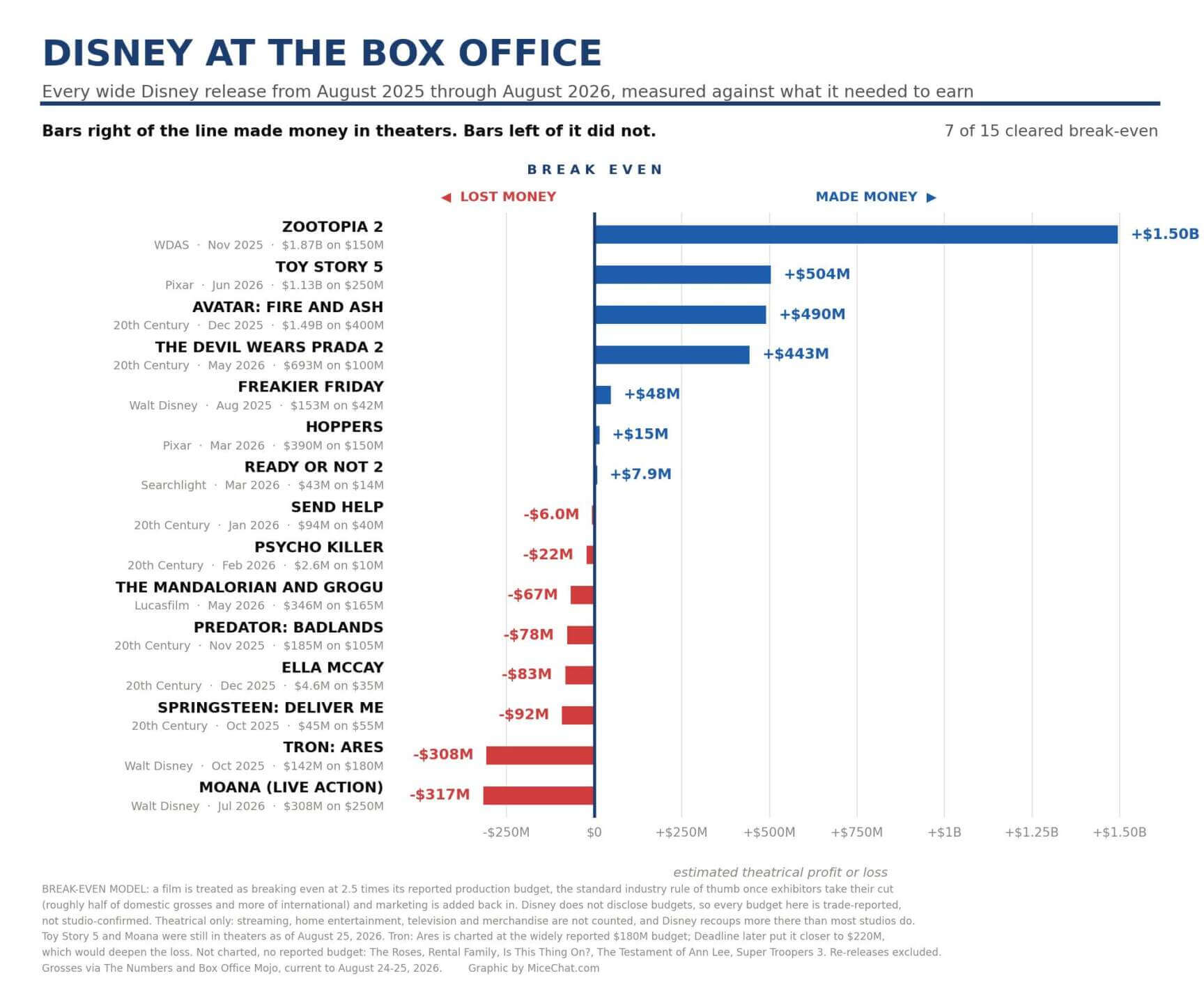
Disney’s last quarter earnings were fairly solid, but less than half of Disney’s films were box office gold. The entertainment industry as a whole is in a time of upheaval, with declining television viewership and revenue plus erratic box office results. All that coupled with mergers and acquisitions among Disney’s rivals creates a reason for Josh to solidify his own stability by removing the leaders of the past and replacing them with his own hand-picked loyalists.
The Memo to Disney Executives
Here’s the letter sent to Disney executives from Senior EVP and Chief People Officer, Sonia Coleman:
Over the past few years, we’ve made real changes to how we operate, and we’re still in that process. As you heard on our most recent earnings call, we’re focused on meaningfully reducing costs as part of our ongoing transformation, so we can continue to invest in the areas that will drive our future growth: content, technology, and experiences. We’ve been evaluating a range of options, and the next phase includes introducing a Voluntary Early Retirement Offer (VERO) for a defined group of eligible executives.
I wanted you to hear about this directly from me before the program launches. The VERO is a time-limited, company-sponsored program that will give eligible executives the opportunity to retire now with an enhanced retirement package that recognizes their service and contributions. This is one of several actions we’re taking to reshape our organization, including involuntary staff reductions that have already begun in some areas and will continue into next year.
By offering a voluntary retirement program, we hope to give eligible employees an opportunity to make a personal decision on their own terms before broader organizational decisions are finalized.
Eligibility has been determined based on established criteria. Those who are eligible will receive separate, personalized communication with details about the offer, the election process, important dates, and available resources.
As leaders, you may receive questions from your teams or colleagues once the program is announced. So that every eligible executive gets the same accurate information, we ask that you direct any detailed questions about the offer to your HRBP or the dedicated People & Culture resources that will launch alongside it.
The program is designed around several important principles:
- A voluntary choice — Participation is entirely optional. No eligible executive is required to elect the offer.
- Recognition of years of service — The enhanced package includes Separation Pay, continued vesting of existing equity awards, healthcare support at active employee rates, and continued Silver Pass access.
- Time to make an informed decision — Eligible executives will have a defined election window, followed by a confirmation period, allowing them to thoughtfully consider what is right for them.
- Dedicated support throughout the process — Comprehensive materials and a dedicated support team will be available to answer questions and help eligible leaders understand the program.
We recognize that retirement from the company is a deeply personal decision. For those who receive this opportunity, our goal is to ensure they have the information, time, and support needed to make the choice that is right for them.
We’re also mindful of what we’re asking of you, as you continue to lead and support your own teams while managing this news. Thank you for your continued leadership as we navigate this next chapter together and for helping ensure this process is handled with the care, respect, and professionalism our people deserve.
Who Isn’t on the List
Read the eligibility list again and notice what’s missing. Disney Entertainment, ESPN, and corporate are named. Disney Experiences, the parks, resorts, and cruise division that D’Amaro ran for five years before moving upstairs, is not.
That omission is worth note. Experiences is the profit engine funding everything else right now, and it’s the division where the new CEO presumably knows most names on the org chart. It’s also the division with roughly $60 billion in announced capital commitments over the next decade, including new ships, the Abu Dhabi park, and the expansions progressing on both coasts.

The other exclusion says something too. Contract employees don’t qualify, and at Disney the most senior executives are almost all on contracts. So the people being invited to leave are the long-tenured Directors, VPs, and SVPs who actually run the day-to-day, while the executives above them will likely stay put.
What It Adds Up To
Do the math on the last five months. Roughly 1,000 positions lost in April. Several hundred more in July, with Pixar losing around 150 people in its deepest cut since 2024 and National Geographic losing just under 100, including a dozen or so at ABC News. That’s somewhere north of 1,500 jobs since D’Amaro took the chair in March, and those are only the ones that got counted publicly. Disney never released a July total, and in July there wasn’t even a company-wide memo. The April cuts got an “I know this is hard” note from the CEO. The July cuts got a spokesperson’s line about “continual evaluation of how it manages resources.”
The 2023 reorganization came with a number, a target, and Bob Iger’s name attached to it. What’s happening now arrives in waves, unannounced and unquantified, making it much harder to write the story of how big this actually is. Whether that’s the goal or just the effect, the result is the same. Disney is being awfully quiet about the scale of these reductions. Will shareholders start demanding a real number?
Then there’s the part a lot of people inside Disney are worried about. On the most recent earnings call, D’Amaro talked about AI handling vacation planning and booking, powering Disney+ recommendations and dynamic ad messaging, and, most interesting for anyone who works in a park, running labor forecasting. He described systems that read attendance trends, seasonal demand, guest flow, and weather to determine where employees are needed before they’re needed. He also said, in the same conversation, that AI should enhance a creative process that is “human-driven and creator-led.” But the AI transition is happening at the same time as the drip, drip, drip of staff reductions.

In the August letter to shareholders, D’Amaro and CFO Hugh Johnston described the company as “mid-stream” on cost reduction and said they’re evaluating “a variety of levers, including reductions in labor and SG&A.” Mid-stream is what stood out to us, and it means Burbank isn’t done with staff reductions, regardless of what they call them or how they are conducted.
And for anyone hoping the VERO is a gentler alternative to layoffs rather than a preview of them, Sonia Coleman’s own memo removes the ambiguity. The program is described as one of several actions, “including involuntary staff reductions that have already begun in some areas and will continue into next year.” Disney is telling its own executives, in writing, that more cuts are coming as it heads into 2027.
D’Amaro spent years building a reputation as the approachable executive, the kind who walked the parks, knew cast members by name, and seemed to genuinely enjoy the job. We don’t think that was fake. But in this new role, he isn’t playing Mr. Nice Guy anymore, and the people who run his television networks are finding that out first.

Disney, like all companies, is reaping the fallout from Mr. “I raised the tariffs, but I did not lower the price of gas.”
Trump isn’t the reason that Disney’s core entertainment assets are struggling. The blame for that falls squarely at the feet of Netflix, Youtube, Tik Tok, and Disney’s inability to compete.
And, ironically, Disney’s apparent inability to use their imagination and create something, rather than just purchasing it.
Disney’s inability to make box office totals is the reason they are making layoffs. The parks are the only thing that’s saving them.
I’m interested in how the company implements scheduling using AI and trends. One of the big complaints I’ve read about are CMs can’t plan their home needs (doctors, kid issues, repairs) due to uncertainty about their schedule. Would the company go to a “be alert you never know” model with AI? The vision is cartoonish but I wonder.
I wonder if Knotts will continue to benefit from Disneys reductions.
Uh. Since knotts was merged with 6 flags they have had large cost cutting measures and drastic price increases
Seems like every time Disney gets rid of some executives– a couple of weeks later they are working for Universal.
Given the GINORMOUS differences in box office between the two, is Disney STILL sure they want to put Avatar in DCA and not Zootopia? Asking for a friend….
Avatar was the most successful park expansion in the history of WDW.
Really? How is that measured? What is your source?
To further my own comment, I just can’t see how, thematically, Pandora fits in DCA. In any part of it. Yet, Zootopia would fit in quite nicely. I mean, for an IP land, which I absolutely abhor.
They could even make it a two-fer, make Zootopia right next to Monstropolis, making one big giant city of IP.
If humans can’t predict staffing needs, neither can AI.
“By offering a voluntary retirement program, we hope to give eligible employees an opportunity to make a personal decision on their own terms before broader organizational decisions are finalized.” Isn’t that saying: If I were you, I’d take the package because your position will likely be terminated? I’m also disappointed that Josh chose to (was asked to, encouraged to, wanted to?) attend the patriot games. What kind of message does that send?
Yes… It’s a threat.
Can’t wait for all this dumb AI nonsense & short-term, quarterly thinking to blow up in Corporate America’s face.
It’s already starting to blow up. You can’t replace creatives with AI. And AI comes at a cost. Now that many AI programs are throttling for high-volume usage or charging an arm and a leg for credits, many companies are starting to regret getting rid of the people who could just do the work!