


We recently filled you in on tense negotiations between Disney and its security officers, which looked like it could possibly end in a strike. Today, we’ll fill you in on what happened next…
Last week, a third attempt to avoid a strike by Disneyland Security and to convince officers to approve a new contract succeeded, despite a majority of those who voted on the new contract rejecting it.
According to a technicality in the international union bylaws, at least half of the members must vote on a proposal, or its fate would be decided upon by the leadership of the local union—the executive board (Local 1955), which had negotiated the contract and had recommended it be ratified. “However,” recounted one officer, “less than half of the 1,600 security officers voted, which sealed its fate. Many had just given up—something Disney was hoping for.”
That means, in theory, the no votes could have outnumbered the yes votes 799-0, and the contract still would have been approved. (Although the exact numbers were not released, officers I contacted speculated the count was closer to 60% no, 40% yes.)
See details of Disneyland Security’s new collective bargaining agreement HERE.
Because the just-ratified contract is nearly identical to a proposal that was soundly voted down just one week earlier, some union members are in disbelief. Several officers immediately began pointing to conspiracy theories.
One guard said the union actually has closer to 1,500 members (if not fewer), but uses the 1,600 figure to make it more difficult for a vote to reach the 50% threshold. (The union board will not tell the membership the exact number of current members.)
Other officers said they would not be surprised at union board shenanigans. As one member noted, “Keep in mind that the board, which wanted the contract ratified, oversaw the voting. There were no independent observers, although they did have two ‘independent’ cast members help count the ballots. The paper votes were collected during the voting process and placed into an acrylic box. The box was secured by a cheap internal lock, of which the board had the key. I am not sure whether the box was left unsecured in the hotel conference room or taken home each night by one of the board members.
“There were many attempts at getting the board to move the voting to a more secure method, however, they were unresponsive. This has added to the distrust of the current board.”
Local 1955 includes four “legacy” members who have been on the board for years. Two of them have been voted out in prior elections, but were quickly reinstated to the board through appointments by the Vice President of Representation and the Treasurer. Some cast members feel the new contract favors specific departments where most of these board members work. As one critic pointed out: “In the union-provided recap, it states that ‘the union will address issues with the K-9 and PCO through MOU’s.’ These Memorandum of Understanding were not spelled out in the contract proposal, and the board refuses to state what they will encompass.”
As well, many members feel as if the head of Local 1955 is in Disney’s pocket. The leader, said one officer, “was handpicked by the International SPFPA (Security, Police and Fire Professionals of America), and he is on record as advocating for a soft approach when negotiating with the company. He appears to be handpicked by the company as well; he is non-responsive and does not seem to put the best interest of the union and its members first—except when it benefits him.”
Many believe that within the next few months, the membership will vote to disassociate with the International SPFPA. (Per an agreement signed in 2021, they can start collecting signatures to force a vote to disassociate starting on July 24, 2026. Once disentangled from SPFPA, the membership will be free to vote for a new local board.
A huge number of officers are certainly fed up. The question will be: do enough of them show up to vote?
ORIGINAL DISNEYLAND SECURITY STRIKE NEWS (MAY 5th, 2026):
For the first time ever, Disneyland Security may be on the verge of going on strike.
Union members overwhelmingly voted down a second contract proposal on May 3, thereby authorizing a strike. Negotiations are set to resume on May 7, with some members claiming they are ready to take the fight to the mat.
Despite a fair bit of saber-rattling over the years, Disneyland Security has never gone on strike before. In fact, it has been rare for any of the park’s divisions to picket during the resort’s 70-plus years. The only large-scale action was a 22-day strike in 1984 that involved five divisions and nearly 2,000 strikers, which permanently tore apart the fabric of the cast member “family.” Today’s Security Department has more than 1,600 union members.
Disney’s Back-Up Plan
Disney, for its part, is taking the threat seriously. The company has already begun training senior management to perform security-specific duties such as working the access gates (drive-in and pedestrian). Managers from the different lines of business will be forced to handle whatever calls affect their division (presumably altercations on attractions would fall under Ride Operations, shoplifting under Merchandising, etc.).
The majority of the training is taking place at the Resort’s EOC (Emergency Operations Center), which is located near the Mickey and Friends parking structure off Ball Road.
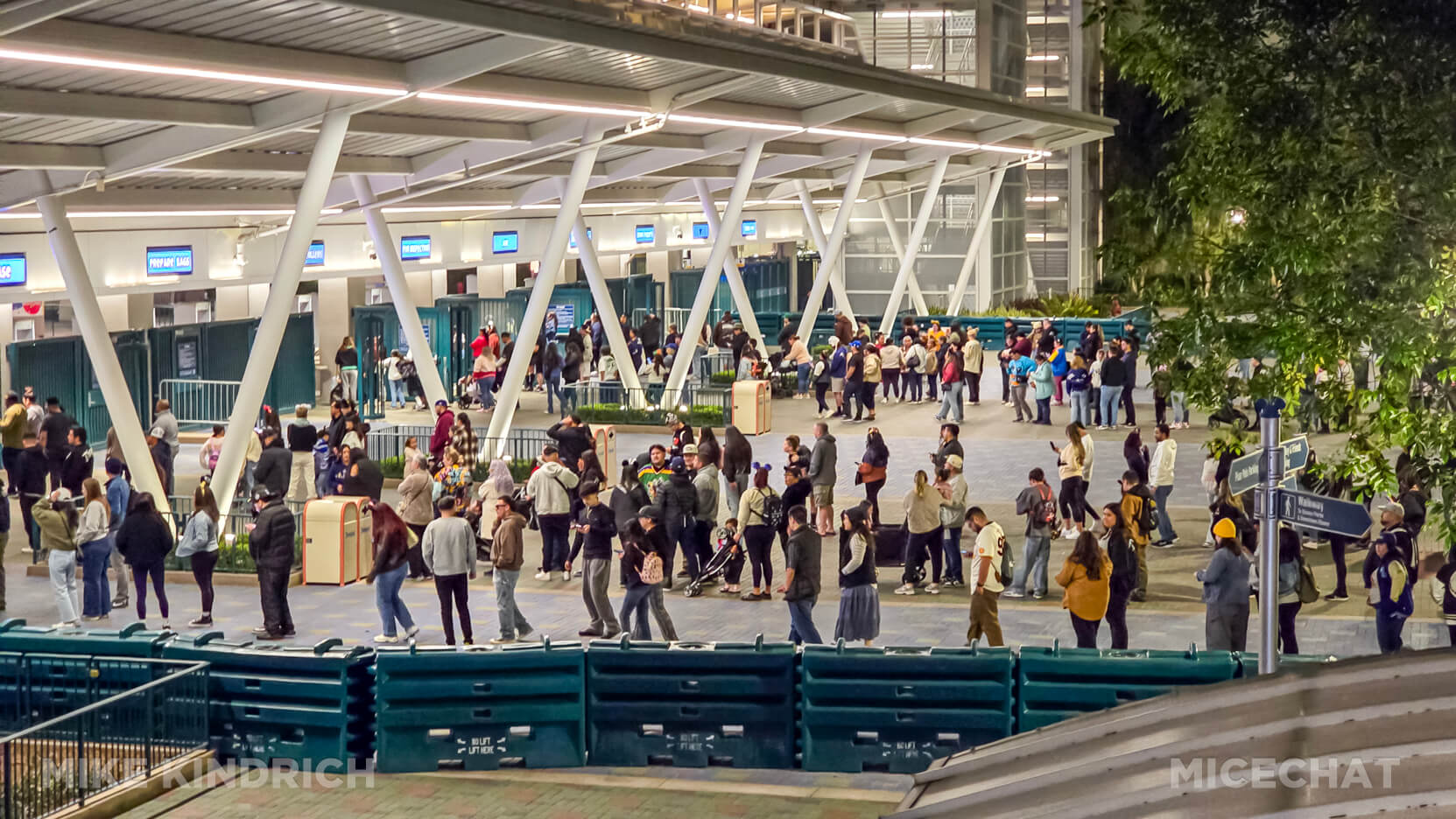
In addition, Disney has reached out to independent security contractors Securitas, CSC (Contemporary Services Corp.), and Allied International and begun training its employees to handle guest screening and bag-check duties. (These companies regularly provide personnel to sporting events, concerts, malls, etc.) Training sessions are underway and scheduled through at least next week. The contractors’ employees have been warned that “this will likely be a last-minute activation, so if you are willing to do the training, please be aware that you may be pulled from scheduled shifts to cover at Disney.”
The resort has pulled manpower from these companies before, allegedly with mixed results. As well, during the park’s construction and 14 months of operation, all security duties were outsourced to the Burns Detective Agency. Walt, however, did not like the brusque nature of many of the guards-for-hire and, in September 1956, had the park form its own Security Division, inoculated in the “Disney Way.”

The just-rejected contract offered a 4% raise in each of the next four years. Effective immediately, general security cast members would earn a minimum of $26 per hour, up to $32.94 (increasing to $29.25 to $37.07 on April 1, 2029). Premiums would be paid to those working graveyard shifts or select positions, such as communication specialists, canine handlers, plainclothes, lookouts, trainers and leads. New hires would earn 90% of the base pay for their first 12 months. Starting in 2028, officers with 10+ years of experience would earn an extra .20 cents per hour, while those with 20 years would get an extra .35 cents an hour.
Other key points include:
- There was no change regarding the lack of seniority in scheduling. The contract continues to state that seniority will be considered in scheduling, but ultimately management can do whatever it wants.
- Walk-time, which currently allows officers to be prepared to clock out 20 minutes before their scheduled off time, may be dramatically reduced. Disney states the benefit is intended only for those who wash their own costumes or must return equipment.
- Whereas currently any discipline remains on an employee’s record for 18 months from the date of the incident, it now would stay on for 18 months from the date management completes its investigation.
Critics’ biggest beef with the contract is the rate of pay. Because of the high cost of living in Southern California, most are looking for starting pay of more than $30 an hour, arguing that a job that exposes them to such daily risks should not be compensated less than some housekeepers and line cooks.

As one officer explained: “Under the Master Services contract, senior ride operators, foods, custodial, and merchandise cast members are being paid as much as us and will be paid more down the line. Why? I have been told and overheard conversations with TDA managers that Security is a ‘non-revenue-generating department.’ In other words, Security is a drain on the company’s revenue. But who gets called out when there is trouble? Us!”
As well, some officers speculated that the lower rate for new hires and the delay of “old-timer” premiums to 2028 incentivize the company to push out more experienced officers.
Whose Side Are You On?
Complicating matters is the officers’ growing distrust of not just their employer, but also of their local executive board (Local 1955) and the parent union, the Security, Police and Fire Professionals of America (SPFPA).
For the contract votes, the union are requiring in-person voting, eliminating absentee ballots (which they claim are for elections only) and online voting (which drew record participation—1,100 members—when last used). The union refused to send out the full contract for members to review, disseminating only a three-page summary, and had just one copy of the full contract on hand to be read at the polling site.
“Our international union doesn’t seem to be helping and even appears to be trying to make it fail,” noted another cast member. “It’s got everyone (furious).”
The previous local union president was suspended by the parent union after reportedly posting updates on the status of negotiations, Disney’s demands, and the union’s counteroffers. His replacement has come under attack by union members for seeming to favor Disney’s interests over theirs, and for refusing to answer emails and calls.
Based on history, a strike seems unlikely. Perhaps most importantly, that’s because the union has no strike fund. Many members can’t afford to miss a paycheck—and Disney knows it.
Since so much of this fight centers on employees feeling slighted, maybe they strike for one day—for the publicity.
Although a majority of members authorized a strike, few actually want to strike. They voted to allow a strike, because the only other option was approving a contract and a system they feel are rigged against them. What they mostly want is to be heard—by their own union and by the company they devote so much to.