



Calico, CA 1893. Unbeknownst to the little mining town, a new gold rush is coming. Two thousand miles away at the World’s Columbian Exposition (also known as the Chicago World’s Fair), a War of the Currents is being fought. DC vs AC. Edison vs Tesla. And scientific discovery is coming to Calico too, whether the citizens of the town are ready for it or not. The electricity of innovation brings Ghost Town Alive.
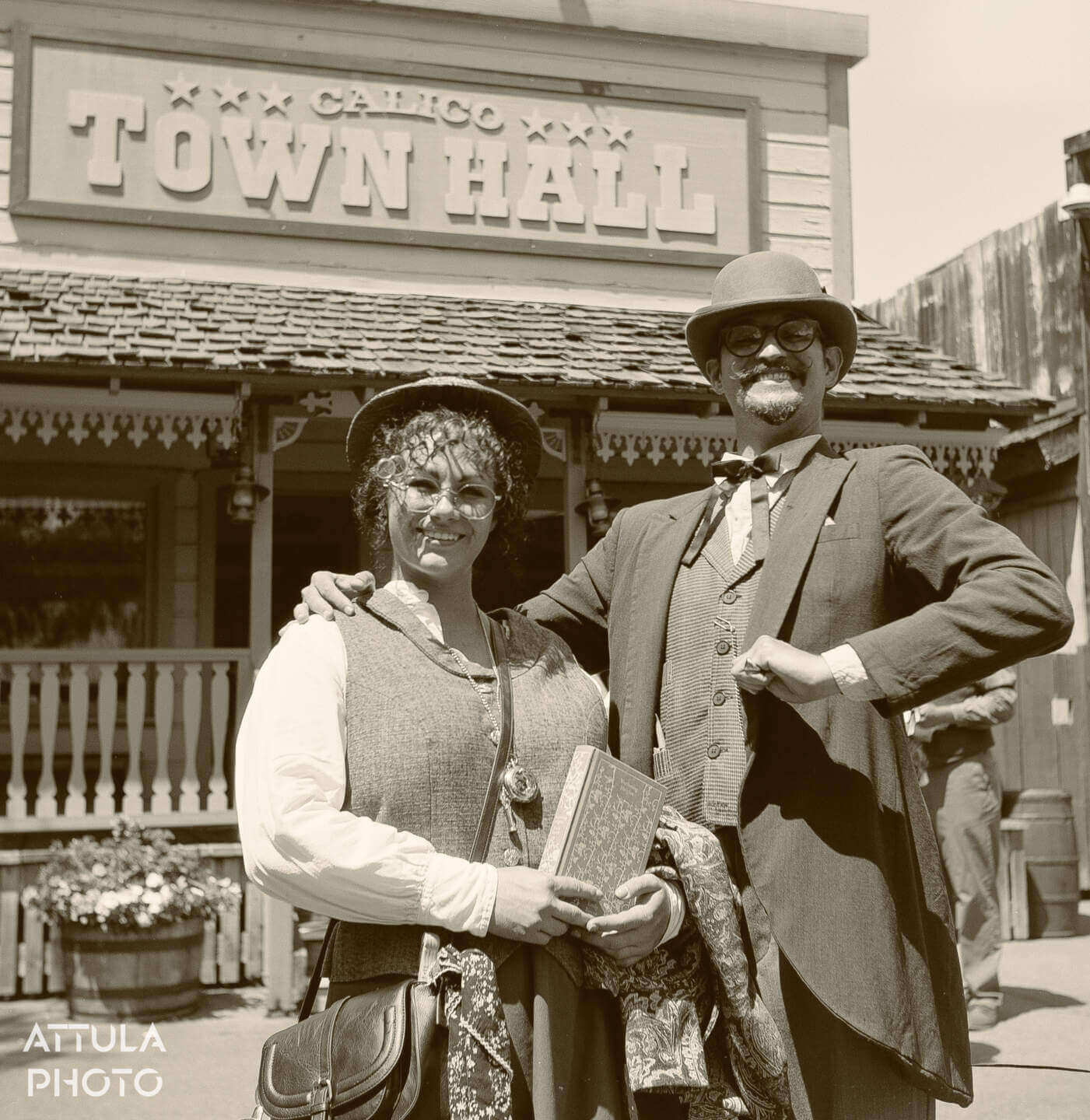
Enter Professor Emmet Watts and his assistant, Phoebe Figglesworth, true believers in the power of electricity. Professor Watts is a former medicine man but has found his new angle in electricity. With all the charisma of a snake oil salesman, he’s learned just enough to be dangerous. Phoebe, on the other hand, is a scholar and knows everything the professor thinks he knows. She’s very drawn to knowledge and is perhaps even more educated than Watts.
The two have discovered the town of Calico through locals Bixby Knolls and Emery Mund who, after visiting the fair and seeing Edison’s kinetoscope, have decided to go into the motion picture business together. Leaving the newspaper and post office behind, Knolls and Mund are two halves of a whole idiot, completely unaware that Professor Watts has not come to Calico to electrify the town as he claims, but instead to get his hands on the Admiral, an electric catfish that was caught during last year’s Founder’s Day. Watts intends to use the Admiral to fuel his electrical experiments, including a generator that runs off the bio-electricity that the fish creates.

This is the inflection point that begins the storyline for this year’s Ghost Town Alive at Knott’s Berry Farm. If you missed our initial coverage of Ghost Town Alive 2024 (or are unaware of the basic premise), please visit our Knott’s Summertime article:
Knott’s Summertime Comes Alive with Food, Music & Entertainment!
To tell the deeper story of Ghost Town Alive, I’ve enlisted the help of show-writer Rovin Dickinson. Along with Halloween Haunt/Scary Farm veteran Jeff Tucker, Rovin has taken over stewardship of the epic western live-action-roleplaying event from the original mastermind, Ken Parks. Further, in keeping with the park’s commitment to authenticity for Ghost Town Alive, all the portraits in this article were shot on orthographic B&W film with a 70-plus-year-old medium format camera. That choice was made because it’s really close to the kind of photography equipment a mining town in 1893 would have (and it just looks incredible). Although it was rather difficult (and expensive) to shoot with. Hopefully, you folks enjoy the extra effort.
Rovin likened this season’s technology infusion to today’s buzz around AI. All the Ghost Town Alive characters have to decide whether to embrace or fear the new technology. Are they for it, against it, or entirely apathetic? Furthermore, how well do you trust the person who’s offering you “the answer to all your problems?”
Bixby, Mund, Watts, and Figglesworth of course are all completely sold on electricity and have their own agendas. Yet, if you venture out into the town and speak with the rest of the cast, they’ll engage in their own way.
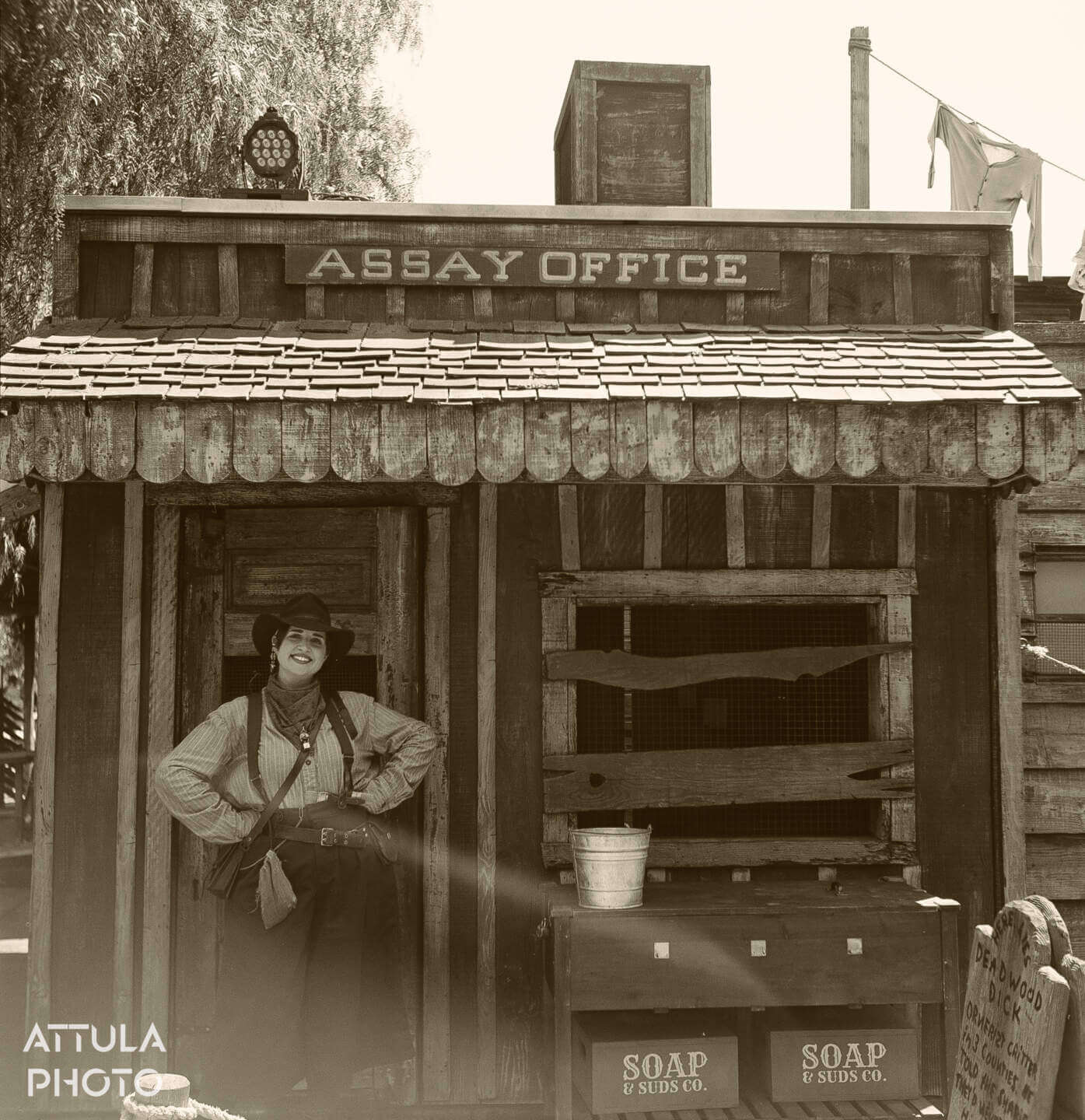
Ophelia Cinch has returned to the town this year after taking a leave from the Calico Mines. Although, her opinions on the Admiral were mostly about whether it would make good fish jerky.
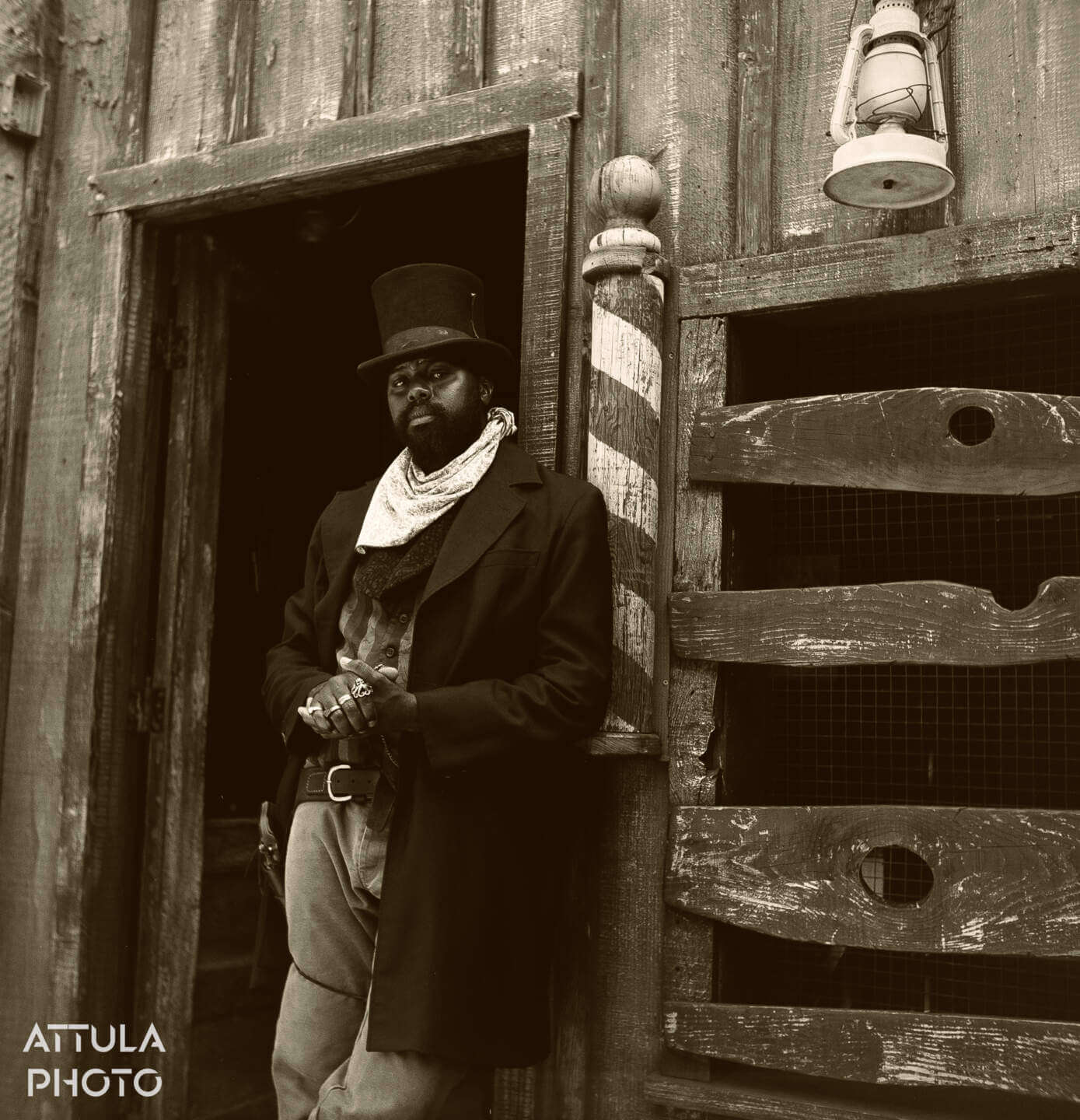
Dr. Dillard Marsh has also come back to Calico hoping to find himself. Electricity was revered as something that can cure ailments like headaches and arthritis. However, most of the conversations in the barbershop were gossip, often about Marsh himself. The doctor seems to have quite the repertoire of ladies vying for his attention…

Another newcomer this year is the Fastest Delivery Girl in the West, Willow McKitrick. When she was employed with the Pony Express, she rode so fast that her buttons flew off, earning her the nickname “Lil Buttons.” Overhearing a conversation, it seems an effort was made to turn McKitrick’s buttons into currency. What might buttons purchase?
Rovin explained that these characters come alive because of the actors and actresses who embody them. They begin as general ideas on paper before becoming developed and rounded citizens of Calico as they interact with the guests (and each other). Those interactions have consequences for how the character develops over the seasons. Some characters are written on a specific path, but others find their own way as their actor or actress matures with the character.

Over the past few seasons, Teddy Delmundo has gone from an innocent dress shop employee to a criminal mastermind. This has happened organically during that time and this season she’s attempted to combine the two rival outlaw gangs and lead them as one criminal empire.

Last season, there was an incentive to commit crimes, which has had a lasting effect. This gave Teddy an appetite for crime, as well as many others in town.

Rovin articulated that Ghost Town Alive characters tend to be created as archetypes. Kid Friday, for example, is the classic deceitful lawyer archetype. He lies, cheats, and cons his way through every situation. Friday was actively conning Teddy into paying him an extra gold nugget to represent her as I was rounding up these portraits.
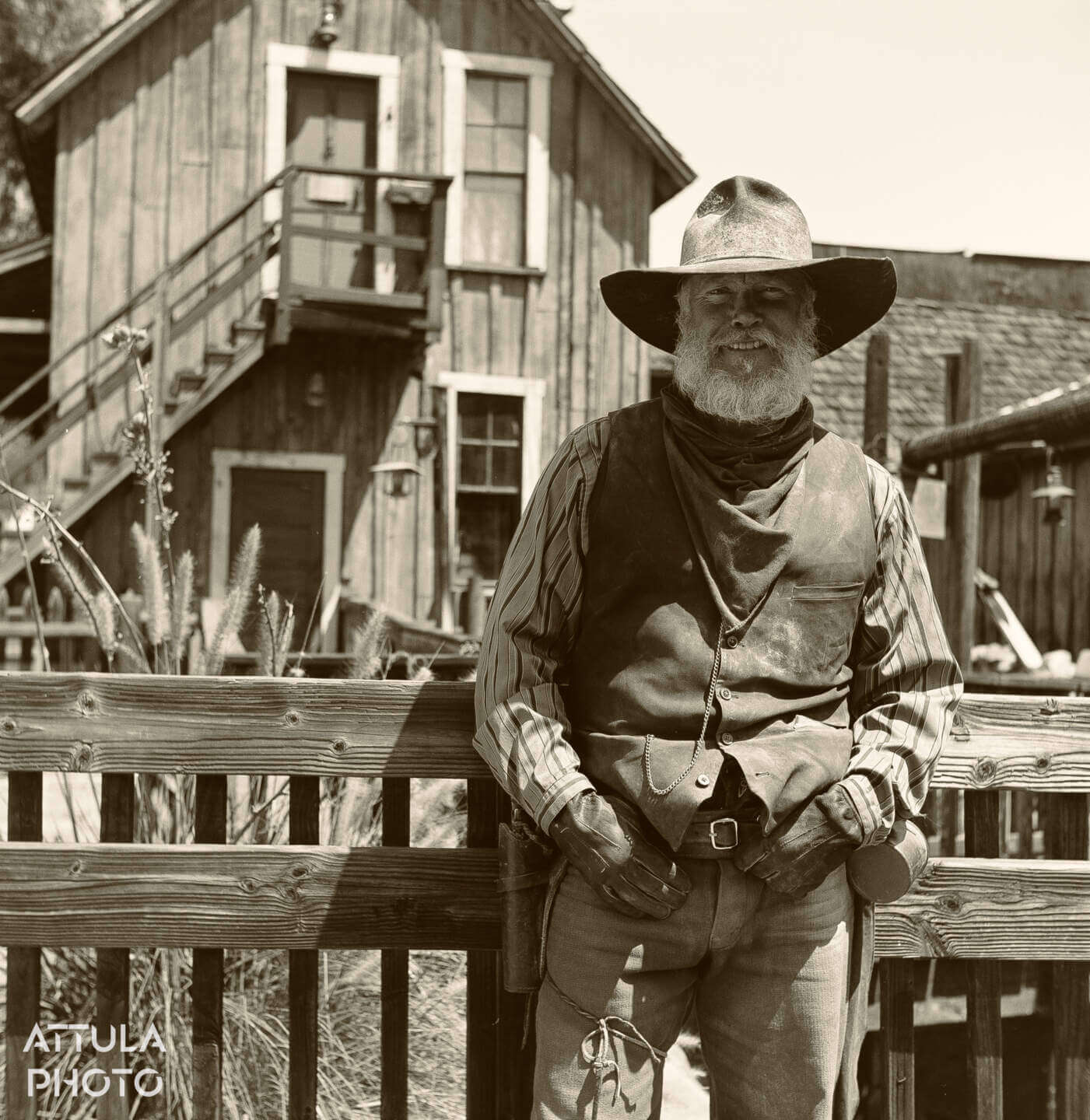
There’s no better Western archetype than the outlaw, and Ghost Town Alive doesn’t shy away from its repertoire of criminal characters. The Mayfields and the Mad Bucks are distinctly different in character, dress, style, and ambition— although neither group can seem to resist robbing the town.

The proposed merger of the two gangs makes for a clever narrative element. What will the new gang be called? Who will lead them? How will the two very different styles clash? The answers unfold as you experience and interact with Ghost Town Alive. The chaos also offers a great distraction from Professor Watts’ sneaky agenda and planned fishy heist of The Admiral.

Rovin pointed out that Ghost Town Alive characters become an amalgamation of everyone they’ve interacted with. What opinions might they form when they’ve lept off the page and become citizens out in Calico? Who might shift their perspective? For those who read the Knott’s Summertime article, I wrote about an interaction that’s a great example of this.
Jasper Witley was campaigning to be the leader of the combined Mayfield-Mad Bucks gang on the platform of “ending capitalism.” Asking one of my family members to be his campaign manager, there was a suggestion of replacing capitalism with a political system coined, “Calicoism”— a clever phrasing for a system that’s essentially an in-theme explanation of the premise of the Ghost Town Alive roleplaying element. Winning the election on the platform of Calicoism influenced Jasper so much that the tale even made it back to Rovin.

Some characters are written to serve a particular narrative purpose like Professor Watts and Phoebe Figglesworth. Others are based on the audition, as sometimes the Knott’s team just loves a performance so much that a new character is born! The Mad Bucks Gang is an interesting case, as they were initially written as the primary narrative element in 2019, much like Watts and Figglesworth are this year, but are now mainstays with their own organic development over the seasons.
This blend of scripted and organic character development keeps Calico’s story ever-evolving with each passing season. The future is here in Calico. Or well, the future of the past. Will Calico embrace it? What consequences will come with the union of the two rival outlaws? Some answers may come during this season’s grand finale— Ghost Town Alive’s final weekend reaches its climactic ending on September 2nd and there are sure to be some big surprises ahead.
If you enjoyed this article (and want to help me cover the costs of the film/development), make sure to share it with your friends and tell us your favorite Ghost Town Alive interactions in the comments below! With that, it’s time to head on down to the Calico Saloon for a cold sarsaparilla. Adios!
