



There’s good news and bad news for Disneyland cast members today. We’ll start with the good news…
Disney Aspire Program Expansion
The Disney Aspire college tuition program, which 13,000 Disney employees are already taking advantage of, is growing. The program was previously for online classes only, but Disney has partnered with California State University Fullerton and Fullerton College to provide in-person classes as well.
Aspire is a Walt Disney Company education and career development program. It offers 100% paid tuition for hourly employees. Aspire participants can select from online or in-person schools that are part of the program.
Unfortunately, it wouldn’t do you much good to do those in-person classes if Disneyland won’t give you the days off you need for coursework and exams…

Disneyland Staffing Issues
The Disneyland Resort now employs well over 30,000 Castmembers. About one-third of that cast is new, and turnover among the existing cast is the highest in recent memory. All of that makes staffing and training more important than ever. Many new cast don’t even finish their training or probationary period before quitting or just failing to show up. And, due to the ongoing health crisis, many more cast are gone for long periods of time, often without adequate backup staff to fill the void. This is one reason why restaurant reservations get canceled and locations that should be operating end up opening late, closing early, or never opening for the day.
This is a problem for everyone. Guests experience a park not quite operating at full efficiency. Managers struggle to fill required roles. And employees are often forced into overtime or have to work stressful shifts in understaffed locations while guests who don’t understand the staffing crisis behave poorly, sometimes even yelling and screaming at them.

The situation isn’t specific to Disney; almost all companies in Southern California are fighting over a dwindling pool of available labor, especially for entry-level jobs such as the Disneyland Resort primarily offers. Generally, a company that needs more employees will offer higher pay, more flexibility, and/or add special perks to entice job applicants.
But Disney is going a different route…
Disneyland Scraps Points System for 3 Strikes HR Policy
Those who work full-time jobs in office settings will be familiar with a 3 or 4-strike HR system which escalates reprimands for attendance violations before terminating an employee. While it’s never fun to be given a warning by your manager, it’s an established and widespread system that mostly works for full-time employees being paid a living wage. The basic idea is to show up for work if you don’t want to lose your job.

But such policies fall apart when you deal with low-wage and part-time workers because they often have special scheduling needs arising from working multiple jobs or juggling school and often childcare as well.

As a result of its low wage and mostly part-time workforce, Disneyland has long adopted a more complicated but also more flexible points system instead of a severe 3 strikes system for attendance issues. The current system allowed enough points for missing a few shifts, and employees were given enough points to deal with most scheduling conflicts with other jobs or schools. And, an employee would only occur points for the first day of a multi-day illness.
But all of that will be out the window in October as Disneyland does away with flexibility and adopts the more strict corporate-style HR strikes system even for lower-wage and part-time theme park workers.
Under the new HR system, newer employees would be fired after their 3rd warning (verbal, written, then final warning); an extra warning is allowed for employees with 5 or more years of service. Disney offers the minimum amount of sick time allowable by California law. After that, the warnings begin. In normal times that might be enough sick time for most employees, but not in extraordinary times such as these.

You can imagine the reaction this news is generating among Disneyland workers who are walking the tightrope of more than one job or shifting school schedules. And single parents with kids have the almost impossible task of figuring out how to deal with sick children and their own illnesses with only 3 strikes available per year. One bout of a highly transmissible virus (such as the ones going around now) making its way through your family and you’d be out of your job at Disney.
While this policy will surely work fine for Disney’s office workers and full-time managers, we suspect that staffing will become an even bigger crisis for this company once this policy is enacted. Rather than becoming a more enticing workplace, Disneyland will suddenly become one of the most restrictive (basically offering the bare minimum of what the State of California will allow). And at current low wages, we aren’t sure Disneyland will be able to successfully compete for the labor needed to properly serve guests.

Worse, the policy seems almost certain to create a wave of illnesses inside the company where employees near their final warning will be forced to come to work sick or risk losing their jobs. This means that their coworkers and guests could also be at greater risk.
How and why this particular policy is being pushed at this difficult moment in time is mind-boggling. At the very least, Disney should push the policy off until health and labor issues moderate. That would also give more time to rethink separate systems for full-time and part-time workers instead of expecting one system to work for two very different types of employees.
Here’s how the new system works. Note that Disney introduces the system by calling it flexible but then proceeds to show how strict it actually is with no examples of flexibility whatsoever.


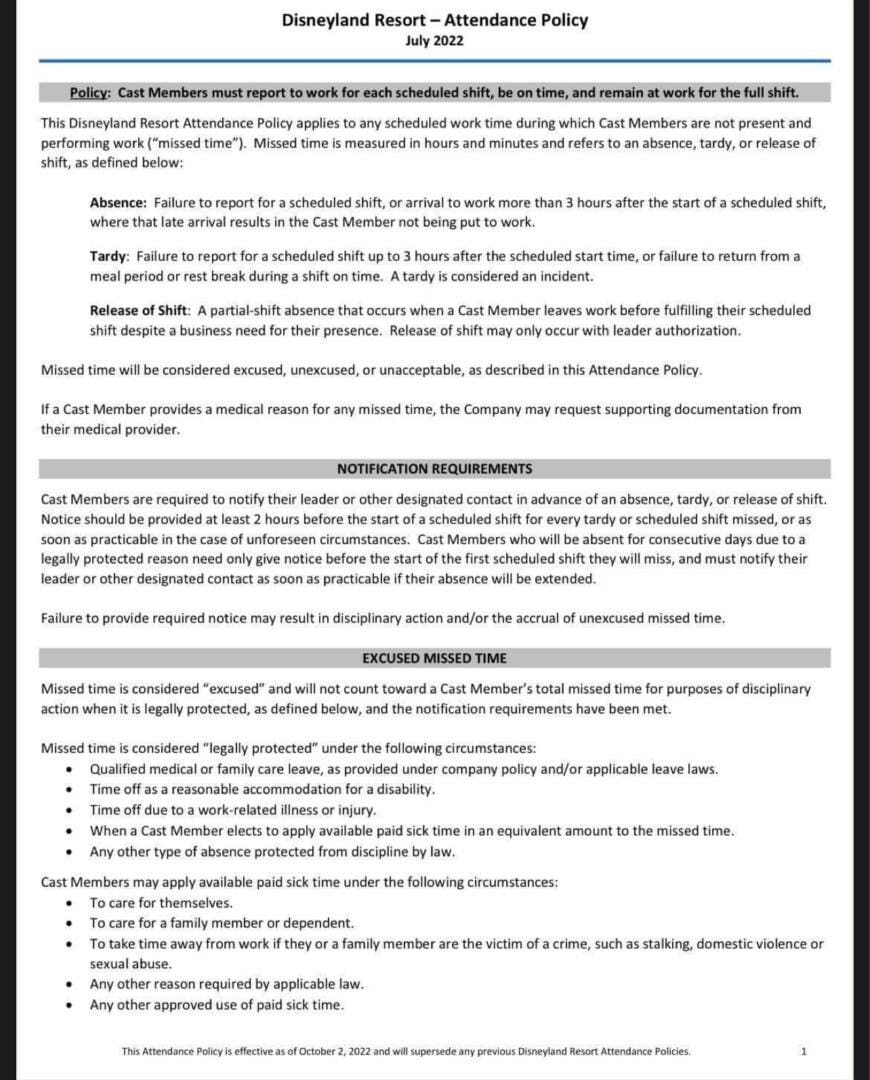

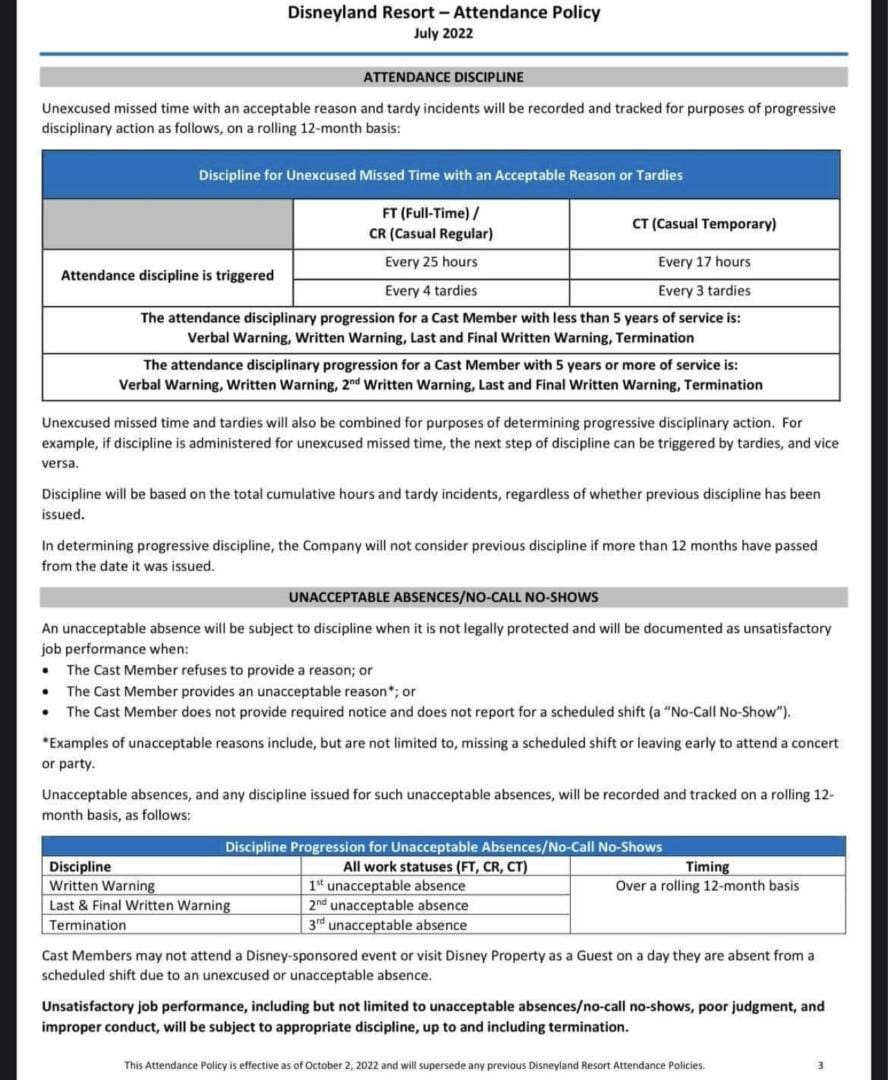
We’ll be keeping a very close eye on this situation. While it is now officially effective October 2nd, there’s still time for Disney to delay the implementation to further negotiate with unions and employee groups. Otherwise, expect a difficult holiday season at the Disneyland Resort as high guest demand meets a shrinking number of cast members.