

Fellow MiceChatters, this is The Spark. In this space, I’ll discuss what it’s like to pursue a career in themed entertainment, trends and developments in the industry, and Disney and otherwise related items on theme park and immersive entertainment history, culture, and more. I hope you’ll enjoy the ride.
Today is the 55th birthday of the man who has made the most significant impact on my life and career: my friend and mentor, Garner Holt, founder and president of Garner Holt Productions, Inc. In the inaugural bit of writing for The Spark, his birthday provides the perfect inspiration to talk about him, and the virtues of mentorship in the creative industry.
When I tell people what I do—usually something like “help create theme park attractions at the world’s largest designer and builder of animatronics”—the reaction I get is most often a wide-eyed smile followed by exclamations on how fun that must be, or questions about how to get into this line of business. What I get to do for a living really is the coolest job in the world—I’ve been enormously blessed to be here. Like many readers, I grew up convinced that I wouldn’t do anything else. Perhaps naively, designing theme parks is really the only career I ever considered.
A native of Southern California, my theme park exposure growing up was rather extensive—Knott’s Berry Farm, Universal Studios Hollywood, and, most of all, Disneyland. My father, a career US Air Force officer, deployed to Operation Desert Storm in 1991, when I was five. To help ease the stress his absence had on my mother, my toddler sister, and me, we began to visit Disneyland almost every weekend. The trend continued for years.
When you visit the park that way—as many readers do—it transforms in meaning, from a remarkable theme park experience, to a functional machine. We anticipate and document change, celebrate history, and observe the workings of the park with increased interest and devotion. The result of realizing that Disneyland did not occur simply by magic was realizing also that maintaining and creating the things people saw and experienced at the park was someone’s job. I decided even then that creating themed experiences was what I was put on the earth to do.
Nearly a decade and a half later—after buying up every book I could find on Disneyland, Walt Disney World, the international parks, and every bit of roller coaster, dark ride, amusement park, and world’s fair literature within reach, coupled with hours and hours totaling whole weeks and months of Roller Coaster Tycoon playing and countless more visits to Disneyland—I found a perfect excuse to visit a company I had read about time and again in connection with animatronics at Disney and other parks. Garner Holt Productions (GHP) is about ten minutes from where I grew up. During college, I worked as a page at the AK Smiley Public Library’s special collections division in Redlands. Under the division’s auspices is a small museum devoted to Abraham Lincoln and the Civil War, the only such institution west of the Mississippi River. The 75th anniversary of the Lincoln Shrine brought reason to inquire about an animatronic Lincoln for the museum—although no one at the Smiley had any intention of buying one, I figured I could build a model of the Shrine and get an audience with Garner about it anyhow.
As fate would have it, Great Moments with Mr. Lincoln is Garner’s favorite show at Disneyland, and the attraction provided much of the inspiration for the founding of his company in 1977. As a result, he was glad to meet with a 19-year-old me to talk about building a version of the show for Redlands’ little Lincoln museum. Meeting Garner for the first time was a bit of a shock—here was a very successful entrepreneur and genius of his trade who was willing to talk with me about a small project for a museum and, what was more, knew as much about Disneyland as I did. Our ten minute business meeting turned into an hour and a half conversation and tour of the plant. I was hooked—although I had always wanted to work for Disney, it was obvious that the old-fashioned days of WED and MAPO were alive and well at GHP.
After a couple months of every-other-day phone calls to the shop, I landed an internship at GHP (NOTE—I don’t consider being annoying the best method for getting a spot at our company, but it did work for me). Garner immediately opened the doors to me to learn about our unique business. Although I worked primarily in the marketing department, I asked to be part of the installation crew for the Finding Nemo Submarine Voyage at Disneyland. Garner allowed me to help build costumes for Chuck E. Cheese, to design sets for Mutual of Omaha’s Wild Kingdom Adventure Tour, to write scripts for shows. He encouraged me in learning all aspects of our creative process—in a move right out of the Walt Disney playbook, he created opportunities for me to dive into creative challenges that I certainly had no business being a part of as a college junior.
One afternoon, Garner asked me if I was interested in learning how to program the movements for some animatronics. I was thrilled. For the show—a pirate-themed pizza restaurant featuring an animatronic parrot and pirate skull interacting with each other in several brief vignettes—Garner sat with me and walked me through the process of programming one function at a time, starting with syncing audio with mouth movements, to create a lifelike show. We talked about his tricks, how he’d learned to program using early implements he’d made himself, to the latest animation consoles we use today. “Take as long as you need,” he said, “To get something smooth and real. Remember that for the thousands of people who will see this, the movements represent our work as much as the feathers and paint. It all has to look good together.” When you consider that, in almost every instance, once programming is finished it never gets touched again, an animatronics programmer has to make sure that he achieves the best performance possible—it’ll repeat the same show for-ev-er. From Garner’s teaching, I continue to program most of our figures today for attractions around the world.
One of the project managers at GHP had a poster in his office that said “If All Else Fails, Communicate.” Communication, the simple act of talking, is the single most important element in the creative process for us and all other organizations in themed entertainment. For me, Garner is the ultimate communicator. As an intern, I would hang out after work and lean on the frame of Garner’s office door, and talk for hours about his career, building the company, what we were working on and what was next. In the simple act of sharing his history and mindset, Garner imparted lessons on entrepreneurship, leadership, and effective use of the imagination that have guided me throughout my career.
In everything, Garner became for me the greatest mentor I could hope to have—creatively as well as from a business standpoint. Organizations like Walt Disney Imagineering and Universal Creative are by definition cost centers to their parent companies. Although their products may make millions of dollars in revenue, the business units themselves are dramatically costly without the evidence of immediate returns in the way film studios can point to profit. GHP, on the other hand, is a small, complete business, and must (at least in theory) turn a profit. I think most readers don’t consider that for all the wonderful things we produce at GHP, everything is done within the sphere of a for-profit small business, with all the challenges that brings.
Creative genius that he is, one of Garner’s best traits is in keeping our company going year after year as a business. Sometimes, this is a real struggle, when the industry is weak on production spending. During those blessedly infrequent lean times, Garner finds ways to not only keep the lights on, but to keep the team complete. I’ve been with GHP for almost a decade, and in that time the core team has never changed; people don’t leave, and Garner does not lay off staff with the cycles that affect others in our industry. As a result, he has preserved the creative team that makes GHP the special organization that it is—in fact, it’s another play from Walt’s book: you can never replicate the best team after it’s been disbanded, so don’t break it up. In that vein, Garner is the sponsor of the “Garner Holt Productions Fast Pitch Competition” at Cal State San Bernardino, part of an entrepreneurial program designed to build effective and creative business leaders from the ground up—the way Garner built his company.
The business of creative design and production for theme parks, attractions, shopping and dining, educational, cultural, and other venues is an entirely unique thing in all the world. It’s a 24 hour a day, seven days a week type of lifestyle, even for most employees. For owners of the dozens of small businesses that today form the backbone of the Themed Entertainment Industry (working for companies like Disney and Universal), the challenge is non-stop. Despite the incredible demands of a life like that, Garner always has the patience and the time to show the process to me and to illustrate bits and pieces of our work. Garner knows that the success of our team lies as much in his leadership as his own creative talents. It lies in the cultivation of creative output in his staff, of explaining to young talent the differences between A-1 and A-100 Audio-Animatronics, pneumatic and hydraulic actuation, sub-system controllers, pressure transducers, plastisol or silicone skins, MFB’s and EFB’s, and on and on
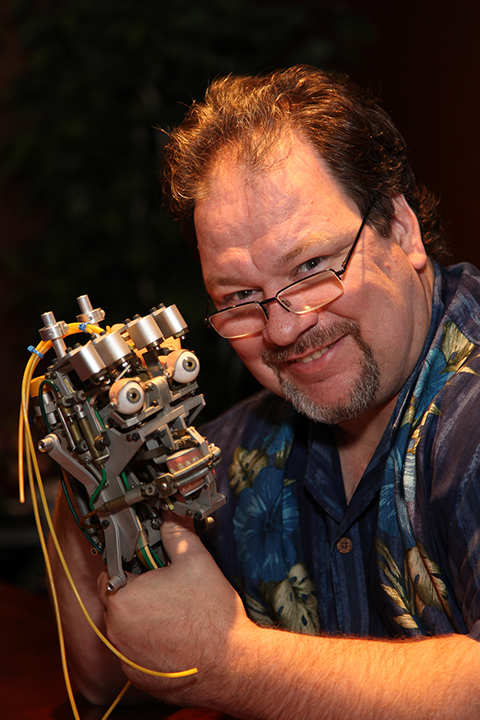
For me, Garner is the essential mentor. He treats our company the way Walt treated WED and MAPO—our output isn’t to meet bottom lines, it’s always to set examples of quality. He has given me the tools to be successful in our arena—a keen imagination is nothing without direction. Ultimately, the role of a mentor is not to develop one person’s skills. Instead, the mentor must develop the skills of an entire cohesive team, individually to ensure motivation and interest, collectively to promote excellence. In theme parks, there is no “me,” there is only “we.” “We did this,” not “Look what I did.”
The last day before reopening the Timber Mountain Log Ride at Knott’s Berry Farm, the GHP crew had been on site for almost 48 hours straight, after being there every day for 12 hour shifts for weeks. I’d been working on programming the animatronics for the attraction; it was one of my duties in my first major attraction as creative director at GHP, a long way from marketing intern. We were all exhausted, totally ready to drop. Garner had been with us much of the evening, but went home for a few hours to sleep before returning to attend the re-dedication ceremonies. As you may recall, that was a tough time, and the ride didn’t get approved to open to the public on its intended day. In the afternoon, some of the crew were allowed to test out the refreshed attraction, which had not been ridden through since shutting down and completely gutting the show scenes some six months before. Garner and I, along with some of our crew, boarded a log and floated swiftly through the scenes that had taken up much of our lives for the past many months in design and production. I was groggy and dispirited at not being quite ready for guests to see our work that first day—but the attraction looked incredible. After we stepped off, Garner turned to me a huge grin, shook my hand and said, “That was amazing! Look what we did!” A moment like that is a remarkable one: approbation from our Walt, where a total novice intern can be part of a team that makes attractions that millions of people will enjoy for generations—thanks to the dedication and the interest of one man.
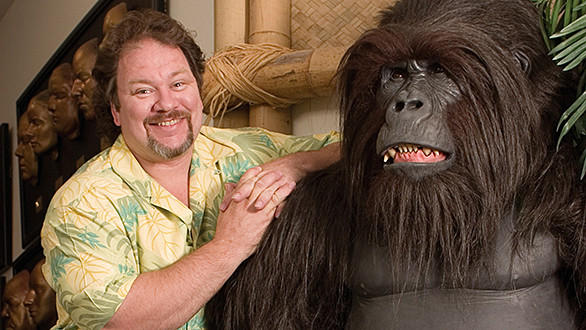
When I speak with up-and-comers in our industry at schools or the Themed Entertainment Association, one of the things that always comes up is mentorship. Nobody in our industry gets anywhere without it. Mentoring can be as a simple as a friendship or as life-alteringly deep as a variety of modern-day apprenticeship. For me, my friend Garner Holt was the key in turning my love of themed entertainment into my calling and my career. I’m eternally grateful for him.
Happy birthday to the greatest mentor I could hope for—Garner Holt.